

Default to a written 24 to 48 hour notice policy, charge a late fee or full session rate for no-shows, and prorate prepaid packages for unused sessions. Put it in the contract, the checkout screen, and the confirmation email. Build in a short exception process for real emergencies. A platform like Athlo that handles coaching bookings and payments in one place makes this whole system easier to enforce without you having to play bad cop over text.
TL;DR:
- A clear cancellation policy should specify a written notice period of 24 to 72 hours, depending on the program's price point and scheduling needs.
- Refunds for prepaid packages must be prorated based on unused sessions at the per-session rate, with clear disclosure of cash or credit options upfront.
- Enforcing late cancellation fees requires a structured escalation process, starting with friendly reminders before applying penalties and documenting all instances precisely.
- The policy must be visible at booking, in confirmation emails, and included in the contract to prevent disputes and ensure client acknowledgment.
- Using a scheduling platform like Athlo helps automate policy enforcement, manage payments, and provide transparency, reducing the likelihood of billing conflicts.
Table of Contents
- What Every Coaching Cancellation Policy Needs to Cover
- Contract Clauses You Can Paste Into Your Coaching Agreement
- Choosing a Notice Window: 24, 48, or 72 Hours
- Fair Refund and Prorating Rules for Packages
- Enforcing the Policy Without Losing the Client
- Copy-Ready Policy Snippets for Your Contract
- How to Process Cancellations and Keep Clean Records
- Why Published Terms Beat Verbal Agreements Every Time
- List Your Coaching Services With Terms That Stick
- Sources
- FAQ
What Every Coaching Cancellation Policy Needs to Cover
A coaching cancellation policy that actually holds up isn't a paragraph buried in your intake form. It's a set of defined rules your client agrees to before money changes hands. Skip any of these pieces and you're negotiating from scratch every time someone bails on a Tuesday session.
Here's what belongs in it:
- Definitions: spell out what counts as a cancellation, a late cancellation, a no-show, and a reschedule request, since clients will argue the gray areas if you leave them open.
- Notice method: require cancellations in writing through a specific channel (email or a support ticket) so you have a timestamp, not a "he said, she said" text thread.
- Refund rules by product type: single sessions and multi-session packages need different rules, because a $75 session and a prepaid ten-pack carry very different financial exposure.
- Exception process: state what documentation you'll accept (medical note, proof of emergency) and how fast you'll respond.
- Where it lives: the policy should appear in the signed contract, at checkout, and again in the confirmation email, since repetition is what actually gets it read.
That last point matters more than coaches think. Clients who see the rule once at signup and never again will genuinely forget it exists by session four.
Contract Clauses You Can Paste Into Your Coaching Agreement
Vague policies create disputes. Specific ones prevent them. Here's language you can adapt directly into your coaching service agreement.
- Cancellation notice clause: "Client must cancel or reschedule at least 24 hours before the scheduled session. Cancellations made with less than 24 hours' notice will be charged the full session rate."
- No-show clause: "A no-show is defined as failing to appear within 10 minutes of the scheduled start time without prior notice. No-shows will be billed at the full session rate and are not eligible for rescheduling."
- Refund and prorating clause: "Refunds for prepaid packages are calculated by multiplying the number of unused sessions by the per-session rate stated in this agreement, minus any applicable processing fees."
- Termination clause: "Either party may terminate this agreement with 14 days' written notice. Fees owed through the effective termination date remain due per the terms above."
Pro Tip: Write your refund math into the contract itself, not just your head. "$600 for 8 sessions = $75 per session" removes the argument before it starts.
When you're formally ending a recurring engagement, a written notice with a stated effective date that references the original agreement closes things out cleanly and avoids billing disputes later.
Choosing a Notice Window: 24, 48, or 72 Hours
Most coaching businesses land somewhere between 24 and 72 hours for cancellation notice, and the right window usually tracks with how expensive and how booked-out your calendar is.
- 24-hour window: standard for most one-on-one coaching, gives clients flexibility without leaving you with an unfillable gap.
- 48 to 72-hour window: makes sense for premium programs, group cohorts, or anything where you'd need real lead time to backfill the slot.
- Booking-window exception: many coaches separately allow a full refund if the client cancels within 24 hours of purchase, before any session was ever scheduled. That's a different rule from session-notice and worth stating separately.
- Program lockouts: once a multi-week program starts, some coaches ban cancellations entirely and only allow pauses or transfers, since mid-program refunds gut the economics of cohort-based work.
A late cancellation inside your window should trigger a fee. Miss the window entirely and it should be the full session charge, no exceptions carved out informally.
Fair Refund and Prorating Rules for Packages
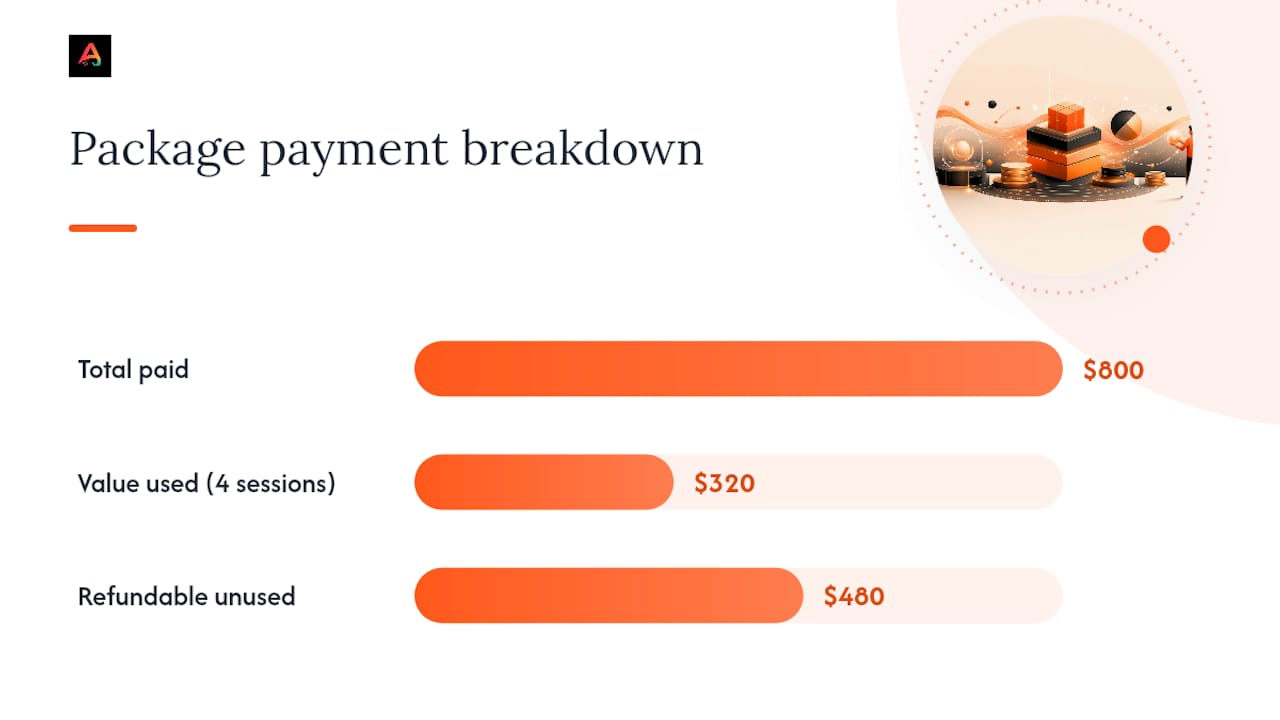
Single sessions are simple: refund or don't, based on your notice window. Packages need a formula, because clients who bought ten sessions and used three deserve to know exactly what they get back.
Prorate by session count, not by calendar time. If a client paid $800 for 10 sessions and used 4, the unused balance is 6 sessions times $80 (the per-session rate), or $480, minus any processing fee you disclose upfront. Some coaches offer credits instead of cash refunds to preserve cash flow, which is fine as long as you say so in writing before the sale.
- Refund unused sessions at the stated per-session rate, never the discounted package rate.
- Disclose whether refunds return as cash or credit before the client buys.
- Set a processing timeline and stick to it, typically 5 to 10 business days for card refunds.
Platform examples like Leland's structure show full refunds within a defined window (14 days from purchase, in their case) with prorating rules layered on top for packages already in use. That two-tier structure, a short buyer's-remorse window plus a separate prorating formula, is worth copying regardless of what you charge.
Enforcing the Policy Without Losing the Client
Enforcement is where most coaches choke. You wrote the policy, but calling it out feels awkward the first time a client tests it. Follow a fixed escalation path instead of improvising:
- First late cancellation: send a friendly reminder of the policy, no fee. People forget things.
- Second occurrence: apply the late fee as written, with a short note referencing the specific clause.
- Pattern of three or more: flag it, document dates and amounts, and have a direct conversation before the next session.
- Exception requests: ask for brief documentation (a note, a screenshot, whatever fits the situation) and respond within a stated window, like 48 hours.
- If the relationship isn't working: terminate cleanly with written notice and a clear effective date, settling any owed fees per the contract.
Documenting the pattern before the conversation turns it from "you're being difficult" into "here are three dates, here's what the contract says." That distinction changes how the conversation goes almost every time.
Copy-Ready Policy Snippets for Your Contract
You don't need a lawyer to write a working cancellation policy. You need language specific enough that nobody can argue with it later. Adapt these:
- Single session: "Sessions canceled with less than 24 hours' notice, or missed without notice, will be charged at the full session rate."
- Package refund: "Unused sessions in a prepaid package are refundable at the per-session rate. Example: a $500 package for 5 sessions refunds at $100 per unused session, less processing fees."
- Reschedule and exception: "Clients may reschedule once per session with 24 hours' notice at no charge. Documented medical or emergency situations will be reviewed case by case within 48 hours."
Put all three somewhere the client actually sees them: the signed agreement, the checkout page if you sell online, and the automated confirmation email after booking. Clients rarely dispute a rule they've seen three times.
How to Process Cancellations and Keep Clean Records
Every dispute you'll ever have traces back to a missing timestamp or an untracked conversation. Run cancellations through one channel, not five.
- Route all cancellation and refund requests through a single email address or support ticket system so nothing gets lost in personal texts or DMs.
- Log the timestamp of the request and the timestamp of your decision, since notice-window disputes come down to minutes, not vibes.
- State your refund-processing timeline up front (5 to 10 business days is standard) and hit it consistently.
- If you book through a marketplace, features like escrowed payments and automated refund triggers remove a lot of the manual back-and-forth.
Pro Tip: Screenshot or export your cancellation log every quarter. If a client disputes a charge months later, you want that record ready in thirty seconds, not buried in a deleted thread.
A documented request process with a set response window keeps exception handling consistent instead of ad hoc, which is exactly what prevents the "well you let my friend reschedule" conversation.

Why Published Terms Beat Verbal Agreements Every Time
Coaches who keep their cancellation terms in a group chat instead of a contract are asking for trouble. Marketplaces that show the policy at checkout and again at booking confirmation cut disputes for a simple reason: the client can't claim they never saw it. Escrowed payments add another layer, since the money isn't fully released until the session actually happens as agreed.
Athlo's coaching marketplace is built around that same logic. Coaches list their services, set their terms, and take secure payments through the app, so the policy travels with the booking instead of living in a separate email nobody reads. If you're running paid sessions, publish your cancellation policy in your coach profile and repeat it in your confirmation message. Redundancy is what actually gets it enforced.
— Abdulazeez
List Your Coaching Services With Terms That Stick
If you're a local coach juggling cash payments, DMs about rescheduling, and clients who "forgot" the cancellation rule, a marketplace built for youth and high school sports changes that dynamic fast. Athlo lets coaches list sessions, take secure payments, and attach clear booking terms that clients see before they ever confirm a slot, so the awkward "that'll be a late fee" conversation almost never has to happen out loud.

Instead of chasing payments or negotiating exceptions from scratch every week, your policy travels with the booking automatically. Download Athlo on the App Store or Google Play , and set up your coaching profile with your cancellation terms built right in.
Sources
- One-on-One Coaching Refund Policy
- How Coaches Can Deal With Late Cancellations And No Shows
- Refund Policy - Leland
- Coaching agreement (Nick Hatter)
FAQ
What is a reasonable cancellation policy for coaching?
A notice window of about one to two days, with appropriate fees for late cancellations or no-shows, covers most one-on-one and small-group coaching situations fairly.
What is the 70/30 rule in coaching?
There's no established cancellation policy rule with a specific percentage split like that; if you've seen such terms elsewhere, they likely refer to different coaching frameworks, not refund or notice-window standards.
What is a typical coach refund policy?
Most coach refund policies refund unused prepaid sessions at the per-session rate rather than the discounted package price, while treating single completed or missed sessions as non-refundable once the notice window has passed.
Are 30-day cancellation policies legal?
Yes, a written notice period such as 14 days for ending a recurring coaching agreement is generally enforceable as long as it's clearly stated in a signed contract both parties agreed to.
How should I cancel a coaching session properly?
Send written notice through the coach's designated channel, whether that's email, a support ticket, or an in-app message, as early as possible before the session start time.
Can a coaching marketplace app help enforce my cancellation policy?
Yes, a platform like Athlo that manages bookings, payments, and confirmations in one place makes your published terms visible at checkout and harder for clients to dispute later.