
Yes, you can get paid to coach youth sports, and most people who want to don't need a teaching degree or years of pro experience to start. Public school districts, competitive clubs, city parks and recreation departments, summer camps, and private lesson clients all pay coaches right now. The median annual wage for coaches and scouts sits at $45,920, and private sessions alone commonly run $40 to $80 for recreational instruction, climbing toward $500 for specialized elite training.
Your fastest way in: pick one lane and move this week.
- Line up one or two private lesson clients through your local sports network or a coaching marketplace app.
- Apply to a part-time rec league role, since most only require a background check and a short safety module.
- Build a one-page coach profile: your sport, age groups, availability, and any certifications.
Pro Tip: Don't wait for the "perfect" full-time coaching job. One paid private client or a single rec-league season gets you a reference, a paycheck, and proof you can do this for real.
Key Takeaways
Getting paid to coach youth sports works best when you combine a stable base role with private lessons and seasonal camps, backed by the right clearances and a fast, direct application strategy.
| Point | Details |
|---|---|
| Start with the easiest entry | Rec leagues and private lessons require minimal credentials and pay the fastest. |
| Get clearances first | Background checks and CPR/First Aid certification speed up hiring across nearly every employer type. |
| Know your pay structure | Hourly, stipend, and per-session models pay very differently for the same hours worked. |
| Stack income streams | Combining a base role with private lessons and camps builds toward full-time income. |
| Use a platform to reduce friction | Athlo pairs coach discovery with secure payments, scheduling, and waivers in one app. |
Table of Contents
- Where People Get Paid to Coach Youth Sports
- How Much Can You Actually Earn Coaching Youth Sports?
- What Certifications and Clearances Do You Need?
- How Do You Find and Apply for Paid Coaching Jobs?
- Practical Ways to Increase Your Coaching Income
- When Do Coaches Get Hired, and When Do They Get Paid?
- Is Coaching Youth Sports Actually Worth It Financially?
- How Coaching Apps and Marketplaces Help You Get Paid Faster
- Legal and Insurance Considerations for Paid Youth Coaches
- Get Paid to Coach with Less Administrative Hassle
- Frequently Asked Questions
- Sources
Where People Get Paid to Coach Youth Sports
The employer you choose determines almost everything else: how fast you get hired, whether you're a W-2 employee or an independent contractor, and how much flexibility you keep.
Public school districts hire coaches through athletic departments, and many require a state coaching certificate or teaching credential, especially for head roles. Pay usually comes as a seasonal stipend rather than an hourly wage, and hiring lines up with the academic calendar.
Competitive clubs and travel teams pay hourly or per-season rates and expect sport-specific credentials, but they move faster than school districts because they are not bound to a district HR calendar.
Local parks and recreation departments are the easiest entry point for most beginners. Formal education requirements are typically absent. Many programs only ask for a background check, a basic safety module, and sport orientation, according to the Sports Coaching Authority. You're almost always a part-time employee or contractor here, paid hourly.

Summer camps hire seasonally, often in a burst between April and June, and pay is usually a flat weekly or per-session rate.
AAU (Amateur Athletic Union) programs and other youth sports organizations post coaching openings on their own sites and at tournaments, and they're a strong option if you want exposure to travel-level competition without the bureaucracy of a school district.
Private lessons and independent coaching put you in full control of pricing and schedule, but you're responsible for finding clients, collecting payment, and covering your own liability insurance.
Job boards like Indeed and ZipRecruiter aggregate listings across all of the above, and coaching marketplace apps such as Athlo add discovery, scheduling, and built-in payments on top of that.
| Employer Type | Typical Pay Format | Time Commitment | Employment Status |
|---|---|---|---|
| School districts | Seasonal stipend | Seasonal, school-year | Employee (often part-time) |
| Competitive clubs | Hourly or per-season | Year-round or seasonal | Contractor or employee |
| Parks & recreation | Hourly | Seasonal, part-time | Employee or contractor |
| Summer camps | Weekly/per-session flat rate | Summer only | Employee (seasonal) |
| Private lessons | Per-session | Flexible, self-set | Independent contractor |
Pro Tip: If you want a paycheck within two weeks, skip the school district application cycle entirely and start with a rec league or private lessons instead. Schools hire on a semester calendar; rec programs and parents don't.
How Much Can You Actually Earn Coaching Youth Sports?
Pay structure varies more than most first-time coaches expect, and picking the wrong one for your situation is the single biggest reason coaches feel underpaid.
Four models dominate the field. Hourly pay is standard at rec departments and camps, typically paying hourly varying by region and sport, often in the low to mid twenties per hour or less. Seasonal stipends are common in school coaching, where a district pays a flat sum for the whole season regardless of hours logged. Per-session or per-player structures show up at some clubs, where you're paid based on attendance or a revenue split with the organization. Private lesson rates are the highest per-hour model available to beginners: recreational sessions commonly start around $40 to $80, while specialized private lessons and elite training can range up to several hundred dollars per session, depending on your sport and credentials.
| Employer Type | Typical Pay Range |
|---|---|
| Rec leagues | $12–$30/hour |
| Club coaching | $40 to $80+/hour |
| Private lessons | $40–$500/session |
| School stipends | Varies by district |
The BLS median of approximately $45,920 a year is a useful benchmark, but it blends full-time program directors with part-time seasonal coaches, so treat it as a ceiling reference rather than a starting expectation. What actually moves your pay: certifications, years of experience, the age and competitive level you coach, your local market, and whether you manage a full program instead of just running practices. A head coach who manages a roster, schedules games, and handles parent communication earns meaningfully more than an assistant running drills.
Pro Tip: Sell private sessions in packages of five or ten instead of one-offs. Package pricing locks in recurring income and cuts the time you spend rebooking each week.
What Certifications and Clearances Do You Need?
Every paid coaching role, even the most casual rec league gig, comes with some kind of screening requirement, and getting ahead of it before you apply saves weeks.
Background checks and, for many states, child abuse registry checks are close to universal for anyone working with minors. Employment eligibility verification is standard for W-2 school and district roles. Beyond that, expect to be asked for CPR, AED, and First Aid certification, plus concussion recognition training, which many districts source through NFHS-affiliated courses. Mandated reporter training is increasingly common at both schools and clubs.
Sport-specific credentials matter more the higher you climb: a USSF license for soccer or an equivalent governing-body certification for other sports signals real competence to clubs and parents alike. For coaches leaning into private lesson work, a methodology credential like an ICF certification can support stronger client relationships and justify higher per-session rates, though it's far from required to start.
School districts tend to ask for more formal paperwork: state licensure or district-specific training modules. Clubs and rec centers usually settle for a safety module plus a sport clinic. At the recreational level, formal education requirements are typically absent; a background check and orientation often cover it entirely.
Before you apply anywhere, gather:
- Government-issued ID and background-check consent form
- Current CPR/First Aid certification
- A one-page coaching resume
- Two references who've seen you coach or lead
- Any sport-specific certification you already hold
CareerOneStop's certification finder is a solid place to locate recognized CPR, First Aid, and coaching credential programs near you.
Pro Tip: Get your CPR/First Aid certification and background check done before you start applying, not after. It's the single fastest way to jump the line on rec and club hiring.
How Do You Find and Apply for Paid Coaching Jobs?
Landing your first paid coaching role usually comes down to hitting the right channels in the right order, not sending out the most applications.
Start local and specific, then widen out:
- Check your local parks and recreation department's coaching page directly.
- Search school district HR portals or athletic department listings.
- Browse club and league websites in your sport for open assistant or head coach roles.
- Set job alerts on Indeed and ZipRecruiter for "youth coach" or your sport plus "coach."
- Watch AAU and tournament organizer sites for seasonal postings.
- Check summer camp listings starting in early spring.
- Build a profile on a coaching marketplace app like Athlo to get discovered directly by parents and organizers.
Before you apply anywhere, put together a simple application packet: a coach resume or profile, two references, proof of your clearances, a short paragraph on your coaching philosophy, and, if you have one, a 60 to 90 second video clip of you running a drill or session.
Networking still beats cold applications in youth sports. Reach out to athletic directors directly, volunteer for a single practice to get your foot in the door, join a local coaching association, and ask parents who've seen you work with kids for introductions to other programs.
Interview and tryout prep matters more than most first-timers assume. Expect questions about how you handle a disruptive player, how you communicate with parents, and how you structure a practice plan. Be ready to run a live 45 to 60 minute demo session covering a warmup, a skill progression, and a scrimmage or game-like activity, since many clubs use this as their actual tryout for coaching candidates. O*NET's occupational profile for coaches lists communication, instructing, and coordination among the top skills employers screen for, which lines up closely with what interviewers actually ask.
Pro Tip: Keep one coach profile updated and attach it to every single application. Rewriting your pitch each time slows you down and produces weaker, less consistent materials.
Practical Ways to Increase Your Coaching Income
Most coaches who reach a full-time income aren't relying on one paycheck. They're stacking a stable base, like a club or school contract, with private lessons and seasonal camps, since solo private lessons alone rarely scale into a sustainable full-time living.
A few moves consistently raise the ceiling:
- Combine a base coaching role with private lessons on your off days.
- Run seasonal camps or one-day clinics to reach new clients at scale.
- Offer package pricing (five or ten sessions) instead of single bookings.
- Set up a referral incentive so current parents bring you new clients.
- Partner with a local gym or field for space instead of renting solo.
- Move from assistant to head coach or program director, where pay ceilings are meaningfully higher.
A one or two day skills clinic is one of the lowest-risk ways to prove your coaching to a room full of prospective private clients at once, turning a single weekend into a pipeline of bookings. Building a repeatable, modular session plan that scales from a one-on-one lesson into a small-group clinic format is one of the more reliable ways coaches boost their effective hourly revenue without adding more hours to the week.
Pro Tip: Treat your first clinic as a sales funnel, not just a paycheck. Every parent in that room is a lead for private lessons next season.
When Do Coaches Get Hired, and When Do They Get Paid?
Hiring cycles differ sharply by employer type, and knowing the calendar saves you from applying at the wrong moment. School districts hire during summer and early fall for the upcoming season. Clubs recruit coaches ahead of travel seasons, often months in advance. Camps hire in late spring for a summer start, and rec leagues typically fill roles just weeks before their season opens.
Pay timing follows the same split. W-2 roles at schools and rec departments pay on standard biweekly or monthly payroll cycles. Contractors and private coaches are usually paid per session, often in cash, by invoice, or through a payment app immediately after the lesson. Camps commonly collect deposits upfront, with your pay tied to enrollment.
- Rec leagues: apply 2 to 4 weeks before season start; first pay typically comes on the next payroll cycle.
- School districts: apply months ahead; stipends often pay out at season's end or in installments.
- Camps: apply by early spring; pay often follows the camp session directly.
- Private lessons: no lead time required; pay usually arrives the same day.
Submitting applications early and having your CPR and background check finished in advance shortens your wait more than almost anything else you can do.
Is Coaching Youth Sports Actually Worth It Financially?
The honest answer: it depends heavily on how you structure it. Paid coaching gives you real flexibility, meaningful work, and multiple ways to earn, but it rarely hands you a stable full-time salary on day one.
The upside: flexible hours you can build around another job, direct impact on kids' development, and a clear path to scale into program management or multiple income streams over time.
The downside: hours are often seasonal and inconsistent, many roles carry no health insurance or retirement benefits, and independent coaches carry their own liability and administrative load.
Realistically, most people coaching for pay in year one are combining it with another job or income source. Coaches who eventually go full-time usually get there by layering a stable base, private lessons, and camps rather than depending on any single stream.
- Track your hourly-equivalent pay across rec work, club coaching, and private lessons to see which mix actually pays best.
- Don't assume a school stipend beats private lesson income; run the math on hours involved.
Pro Tip: Calculate true hourly pay by dividing total season income by total hours, including practice, travel, and prep time. The number often surprises coaches who assumed the stipend job paid best.
How Coaching Apps and Marketplaces Help You Get Paid Faster
Coaching marketplace apps solve a problem every independent coach eventually hits: finding clients and collecting payment without turning it into a second job. Look for a searchable coach profile, in-app booking calendar, secure payment processing, reviews, and built-in waivers or medical forms.
These features cut real time off the path to your first paycheck. Instead of chasing leads through word of mouth, your profile puts you in front of parents actively searching for a coach in your sport and area, and reviews from past clients build trust faster than a cold pitch ever will.
Athlo brings coach discovery, secure in-app payments, scheduling, and waivers into one place, alongside features like QR-ticketed events for clinics and camps. That combination matters if you're running both private sessions and the occasional group clinic, since you're not juggling three separate tools to get booked and paid.
Pro Tip: Pick a platform with built-in payment protection and scheduling before you scale to multiple clients. Manually invoicing five private clients a week eats hours you could spend coaching instead.
Legal and Insurance Considerations for Paid Youth Coaches
Getting paid to coach changes your legal exposure, and it's worth understanding before your first session, not after an incident.
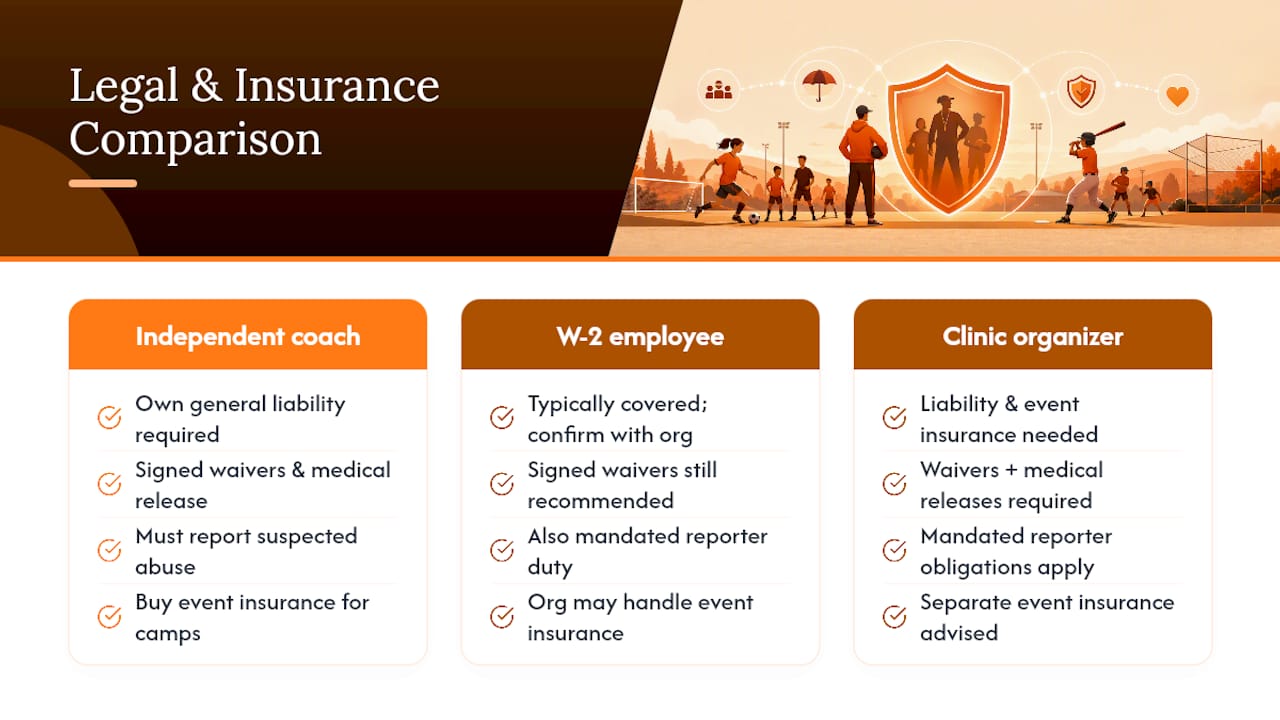
Independent coaches, in particular, need their own liability insurance. If you're a W-2 employee at a school or club, you're typically covered under the organization's policy, but confirm this directly rather than assuming it. Contractors and private coaches almost always need to carry their own general liability coverage, since a parent's homeowner policy or a single incident during a lesson can otherwise become a personal financial risk.
Waivers and medical release forms are standard practice for any paid youth coaching relationship, private or organizational. These typically cover assumption of risk, emergency medical authorization, and photo/video release if you plan to use session footage for marketing. Keep signed waivers on file for every athlete you work with, not just the ones in group settings.
Mandated reporter obligations apply broadly to anyone working with minors in most states, meaning you have a legal duty to report suspected abuse or neglect, regardless of whether you're an employee or a contractor. Check your state's specific requirements rather than assuming your certification training covered it fully.
If you're organizing your own clinics or camps, event insurance separate from general coaching liability may be necessary, especially for larger group sessions. Digital waiver and medical form tools built into coaching apps make this easier to manage at scale than paper forms ever were.
A Coach's Take: Start Small, Scale Fast
The fastest path into paid coaching isn't the school district application. It's one private client or one rec-league team, taken seriously enough to turn into a reference. Build a repeatable session plan you can run in your sleep, put your profile somewhere parents can actually find it, and ask every satisfied client for one introduction. That's how a side gig turns into a real income stream within a season, not a year.
Get Paid to Coach with Less Administrative Hassle
The channels covered here, rec departments, school HR portals, job boards like Indeed and ZipRecruiter, all work, but each one still leaves you handling scheduling, payment collection, and waivers on your own once you land the gig. Athlo is built specifically to close that gap for coaches and organizers who want to spend their time coaching, not chasing invoices.

The app combines a coach discovery marketplace with secure in-app payments, a booking calendar, medical forms and waivers, and QR-ticketed events for camps or clinics, all in one place. If you're coming off this article ready to line up your first paid client or list your availability for local parents to find, that's exactly what Athlo is built for. Create your coach profile on Athlo and start getting discovered by parents and organizers looking for someone exactly like you.
Frequently Asked Questions
Can you really get paid to coach youth sports without prior experience? Yes. Recreational leagues and many camps hire beginners with just a background check and a basic safety module, and private lesson clients often care more about your playing background and communication than formal credentials.
How much do youth sports coaches typically make? The median annual wage for coaches and scouts is $45,920, though pay varies widely by employer type, with rec leagues around $12 to $30 an hour and private sessions ranging from $40 up to $500 depending on specialization.
Do I need a certification to coach youth sports for money? Not always at the recreational level, but CPR, First Aid, and a background check are close to universal requirements, and sport-specific or governing-body certifications raise your pay ceiling significantly.
What's the fastest way to start earning as a coach? Line up one or two private lesson clients or apply to a local rec league role. Both typically move faster than school district hiring cycles and get you your first paycheck within weeks.
Is coaching youth sports a good full-time career? It can be, but most coaches who go full-time combine a stable base role with private lessons and seasonal camps rather than relying on any single income source.
Sources
For ongoing salary benchmarking and job hunting: the BLS Occupational Outlook Handbook, O*NET's coach profile, CareerOneStop's wage lookup, Indeed, ZipRecruiter, and your local parks and recreation department page.
- Coaches and Scouts : Occupational Outlook Handbook
- How to Become a Sports Coach: Education, Experience, and Licensing | Sports Coaching Authority
- O*NET OnLine: Coaches and Scouts (27-2022.00)