

Coach management software is defined as any digital platform that consolidates scheduling, payments, communication, and athlete records into a single system. Understanding how sports apps simplify coach admin starts with one uncomfortable fact: coaches spend 30–40% of their workweek on tasks that have nothing to do with coaching. That is 10–15 hours every week spent on emails, invoices, schedule changes, and paperwork. Unified sports apps eliminate most of that overhead by automating repetitive workflows and keeping every stakeholder connected through one platform.
How sports apps simplify coach admin through automation
The administrative burden on coaches is not just inconvenient. It actively reduces the quality of coaching. When you spend Tuesday night chasing down permission slips and Thursday morning resending payment reminders, your mental energy is gone before practice even starts.
Sports apps address this by automating the tasks that repeat most often. The most common manual admin tasks coaches face include:
- Scheduling: Creating practice and game calendars, notifying parents of changes, and managing field bookings
- Payments: Sending invoices, tracking who has paid, and following up on overdue fees
- Communication: Relaying updates to parents, athletes, and assistant coaches across multiple channels
- Documentation: Collecting medical forms, waivers, and attendance records
- Athlete data: Logging session notes, tracking progress, and storing health information
Scheduling automation alone eliminates a significant category of errors. When a game gets rescheduled, a good sports app pushes that update to every parent and athlete instantly. No phone tree. No group text chaos. Automated notifications reach parents and staff the moment a change is made, cutting inbound calls and follow-up messages to near zero.
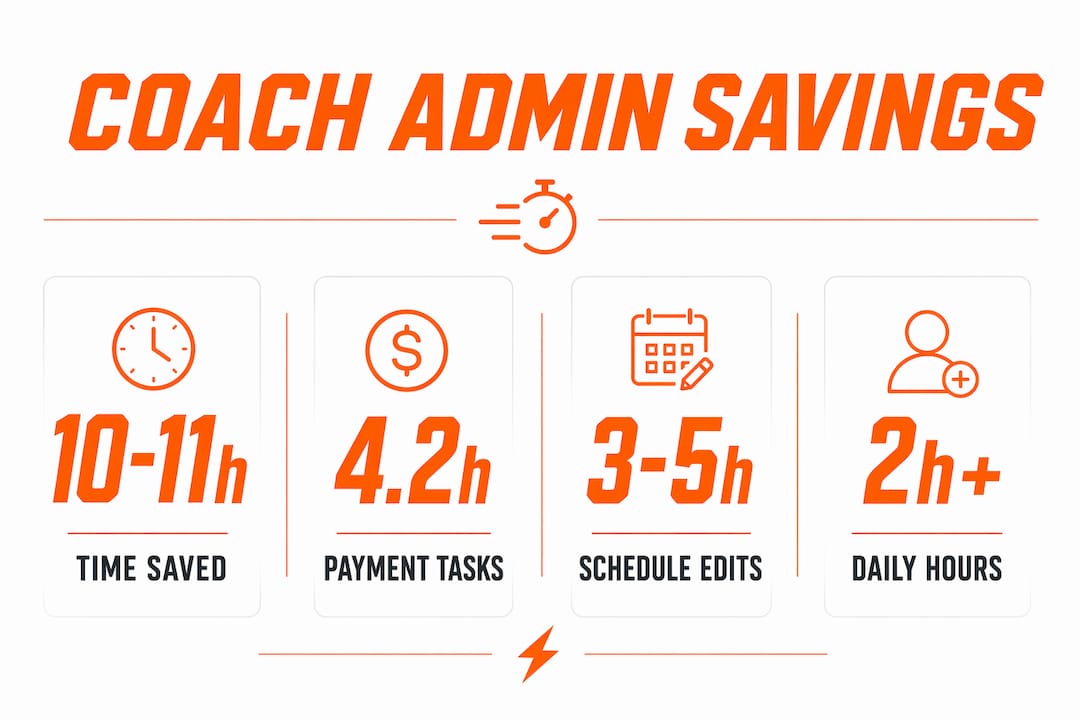
Payment automation works the same way. Coaches typically spend 4.2 hours monthly on repetitive financial tasks like sending invoices and chasing late payments. Triggered payment reminders and access controls for overdue accounts handle all of that without a single manual action.

Pro Tip: Set your payment reminders to fire automatically three days before a due date and again on the day itself. Most coaches who do this report a sharp drop in late payments within the first month.
How do integrated apps differ from fragmented tool stacks?
Most coaches do not start with a fragmented system by choice. They add tools one at a time. A group chat for communication. A spreadsheet for attendance. A payment app for fees. A separate calendar for scheduling. Before long, you are running five or more apps that do not talk to each other.
This is the five-app problem. Every time you switch between tools, you pay a cognitive cost. You lose context. You make copy-paste errors. You miss follow-ups because the information lives in a different app than the one you are currently using. The result is mental fatigue that shows up in your coaching, not just your admin.
Fragmented tool stacks also create inconsistent communication. A parent who gets a schedule update through one channel but misses a payment reminder sent through another loses trust in the process. Unified systems improve the client experience by automating consistent follow-ups and keeping every message in one place.
The real benefit of consolidation is not adding more features. It is reducing fragmented handoffs that waste time and mental effort. When scheduling, billing, notes, and stakeholder reporting all live in one system, data does not need to be transferred manually between tools. That alone eliminates a category of errors that coaches rarely even notice they are making.
One important distinction: not every all-in-one platform is built for live coaching. Platforms designed for digital content creators often lack the real-time session management features that youth and high school coaches actually need. A platform built for selling online courses will not handle game-day logistics or parent notifications the way a coach-specific app does.
Pro Tip: Before committing to any platform, test it against your three highest-friction admin tasks. If it does not handle all three natively, keep looking.
What time and operational savings do coaches actually gain?
The numbers here are specific enough to be useful. Coaches who consolidate admin workflows into an integrated platform reclaim 10–11 hours per week. That is the equivalent of a part-time job's worth of time returned to actual coaching.
A veteran athletic director who moved scheduling, communication, and payments into a single system saved 2+ hours daily. That is not a rounding error. That is time that went back into athlete development, staff coordination, and program planning.
The breakdown by task category shows where the savings concentrate:
| Admin task | Manual time cost | With app automation |
|---|---|---|
| Scheduling and change notifications | 3–5 hours weekly | Under 30 minutes |
| Payment invoicing and reminders | 4.2 hours monthly | Near zero |
| Parent and staff communication | 2–4 hours weekly | Automated, real-time |
| Onboarding new athletes | Hours per athlete | Under 5 minutes |
Onboarding is a particularly striking example. Centralized scheduling systems reduce onboarding time from hours to under five minutes by syncing schedules instantly and routing role-based notifications to the right people automatically. For a coach adding ten new athletes at the start of a season, that difference is measured in days, not hours.
The financial automation piece deserves its own emphasis. When payment reminders are triggered automatically and overdue accounts are flagged without manual review, coaches stop being their own billing department. That mental shift matters as much as the time savings.
How can coaches successfully adopt sports apps?
Adoption fails most often when coaches try to automate everything at once. The better approach is to start with the tasks that cause the most friction and work outward from there.
- Centralize payments and communication first. These two categories generate the most manual work and the most parent contact. Getting them into a single system produces immediate, visible results.
- Establish one source of truth for attendance and schedules. Every stakeholder, parents, athletes, and assistant coaches, should pull information from the same place. Conflicting schedules across multiple platforms are a leading cause of missed games and frustrated families.
- Avoid over-automating personal interactions. Automated reminders and schedule updates work well. Automated responses to individual parent concerns do not. Keep the human touch where it matters most.
- Evaluate platforms against live coaching needs. A platform built for asynchronous digital content will not serve a coach running real-time practices and weekend tournaments. Test for game-day notification speed, parent self-serve access, and mobile usability.
- Scale your automation as your roster grows. The hidden costs of context switching become significant once you are managing more than 10 active athletes. That is the point where consolidation stops being a convenience and starts being a necessity.
The adoption process works best when coaches treat the platform as a single source of truth from day one. Importing existing schedules, athlete records, and payment history before the season starts prevents the parallel-system problem where the old spreadsheet and the new app both exist and neither is fully trusted.
Pro Tip: Run one full season with your new platform before evaluating whether to add any additional tools. Most coaches discover they need fewer features than they thought, not more.
Key Takeaways
Sports apps reduce coach admin by consolidating scheduling, payments, communication, and athlete records into one system, reclaiming up to 11 hours per week.
| Point | Details |
|---|---|
| Admin time is significant | Coaches spend 30–40% of their workweek on non-coaching tasks, totaling 10–15 hours. |
| Automation targets the right tasks | Payments, scheduling, and notifications are the highest-volume tasks and the fastest wins. |
| Fragmented tools cost more than time | The five-app problem creates mental fatigue, data errors, and inconsistent parent communication. |
| Platform fit matters | Choose apps built for live coaching programs, not digital content creation tools. |
| Scale triggers consolidation | Managing more than 10 athletes makes a unified platform a necessity, not a preference. |
Why I think most coaches are solving the wrong problem
Coaches who feel buried in admin usually go looking for a better tool. What they actually need is fewer tools. I have watched coaches add a fifth app to fix a problem created by the fourth app, and then wonder why nothing got easier.
The real issue is not that any single tool is bad. The issue is that every additional app you use becomes a job in itself. You have to check it, update it, and translate information from it into every other system you run. You become the human connector between platforms that were never designed to talk to each other. That is not efficiency. That is overhead wearing a productivity costume.
Coach-specific platforms solve this because they are built around the actual shape of a coaching week: practices, games, parent updates, payments, and athlete records. A platform designed for selling online courses does not know what a game-day notification is. A general project management tool does not have a parent portal. The specificity of the platform is what makes the time savings real.
The coaches I have seen get the most out of sports apps are the ones who commit fully. They delete the spreadsheet. They stop using the group chat. They put everything in one place and trust the system. That commitment is uncomfortable for about two weeks and then it becomes the only way they can imagine working.
Athloapp is built around exactly this kind of integration, connecting scheduling, live scores, payments, medical forms, and parent communication in one place. That is the direction the whole category is moving, and coaches who adopt it early get the compounding benefit of cleaner data and faster decisions over time.
— Abdulazeez
Athloapp brings your coaching admin into one place
Coaches running youth and high school programs need a platform built for the real demands of live sports, not a generic productivity tool retrofitted for athletics.

Athloapp consolidates the admin tasks that eat your week: scheduling with instant parent notifications, QR-ticketed events, secure payment processing through a coaching marketplace, medical forms and waivers, DragonFly sync, AI video analysis, and a parental view that keeps families informed without requiring your direct involvement. Every feature is built for the pace and complexity of youth and high school sports. Coaches and organizers get paid reliably, parents stay connected, and athletes get more of your attention where it counts. Available on iOS and Android.
FAQ
How much time can a coach save with a sports app?
Coaches who consolidate admin into an integrated platform reclaim 10–11 hours per week. One athletic director reported saving 2+ hours daily after centralizing scheduling, communication, and payments.
What admin tasks do sports apps automate best?
Sports apps handle scheduling, payment reminders, parent notifications, athlete onboarding, and attendance tracking most effectively. These are the highest-volume tasks and produce the fastest time savings when automated.
Are all-in-one sports apps suitable for youth and high school coaches?
Yes, provided the platform is built for live coaching programs. Platforms designed for digital content often lack real-time session features that youth and high school coaches require.
When should a coach switch from multiple tools to a single platform?
Consolidation becomes necessary once you manage more than 10 active athletes. Beyond that threshold, context switching costs more time than the platform fees save.
Does automation replace personal communication with parents?
No. Automation handles schedule updates, payment reminders, and routine notifications well. Direct conversations about individual athlete concerns should remain personal and coach-led.