

The three highest-impact things you can do as a sports parent are: back your kid emotionally without conditions, praise effort over outcome, and keep your involvement moderate enough that the sport stays theirs, not yours. That's it. That's the whole playbook, according to a 2024 systematic review of 29 studies covering 9,185 young athletes. Everything else in this guide is detail work.
Use this at your next game or practice:
- Say "I love watching you play" instead of critiquing the game on the ride home.
- Ask "What was fun today?" before "Did you win?"
- Let the coach coach. Zip it on tactics, even when you're right.
- Notice effort out loud: hustle, recovery from mistakes, teamwork.
- Skip the sideline commentary entirely, including the encouraging kind shouted mid-play.
Further down, you'll find printable scripts and a weekly routine template you can actually stick to.
Key Takeaways
Supporting your child's autonomy, focusing on effort over outcome, and keeping your involvement moderate together predict better enjoyment, motivation, and long-term participation in sport.
| Point | Details |
|---|---|
| Support beats pressure | Perceived parental support links to enjoyment, while pressure links to amotivation in young athletes. |
| Moderate involvement wins | The 2024 systematic review found autonomy-supportive, moderately involved parenting outperforms win-at-all-costs pressure. |
| Shift roles by age | Move from Manager in elementary years to Meaning-Maker in middle school to Model by high school. |
| Watch for burnout signals | Dread, physical complaints, and withdrawal for several weeks signal it's time to reduce intensity or support a break. |
| Use tools to cut friction | Athlo centralizes schedules, messaging, and medical forms so parents can focus on supportive behavior instead of logistics. |
Table of Contents
- Why Parent Sports Involvement Best Practices Actually Matter
- Core Principles Behind Positive Parent-Athlete Relationships
- What Should You Do (and Avoid) on the Sideline and at Home?
- How Do You Talk to Your Child and Their Coach?
- What Does Good Involvement Look Like at Each Age?
- What Are the Warning Signs of Burnout, and When Should You Step Back?
- How Do You Turn These Principles Into a Weekly Routine?
- What's a Simple 3-Step Plan for This Season?
- A Coach and Parent's Honest Take on Getting This Right
- How Athlo Makes Supportive Involvement Easier to Sustain
- Sources
Why Parent Sports Involvement Best Practices Actually Matter
Here's the uncomfortable part: most sports parents think they're helping. The research says otherwise, more often than you'd expect. A 2013 study of 723 young athletes (mean age 12.37) found that kids who perceived their parents as supportive reported significantly more enjoyment in their sport. Kids who perceived pressure from parents, even well-meaning pressure, trended toward amotivation, the technical term for when a kid stops caring whether they even show up.
The 2024 systematic review is the clearest data point available right now. Researchers pulled together 29 studies, spanning 9,185 athletes and 2,191 parents, and landed on a consistent pattern: the parenting styles linked to better outcomes were autonomy-supportive, moderately involved, and focused on effort over winning. Parents chasing a win-at-all-costs climate correlated with worse motivational outcomes across nearly every study reviewed.
This all maps onto Self-Determination Theory, the psychological framework researchers keep returning to. SDT says human motivation runs on three needs:
- Autonomy — feeling like the sport is a choice, not an obligation.
- Competence — feeling capable of getting better, not just judged.
- Relatedness — feeling connected to teammates, coaches, and yes, parents, without conditions attached.
Starve any one of those three and motivation erodes, sometimes quietly, sometimes in the form of a kid suddenly announcing they're "done with soccer forever" three weeks before playoffs.
There's a longer-game reason to care too. Longitudinal research tracking athletes from adolescence into adulthood found that parental support during the teen years significantly predicted whether someone stayed active in sport as an adult, a relationship strong enough to hold at p < 0.001 for male participants in that study. The way you show up on a random Tuesday practice in eighth grade may echo into whether your kid still plays pickup basketball at 30.
Core Principles Behind Positive Parent-Athlete Relationships
Strip away the jargon and the research boils down to six habits worth memorizing. Think of these as your default settings, the things you fall back on when you're tired, it's raining, and your kid just missed an easy shot.
- Support autonomy. Let your child choose their sport, their effort level, and eventually, when to quit. A kid who picked this themselves shows up differently than one being steered.
- Build relatedness. Show unconditional warmth regardless of performance. A hug after a rough game means more than a breakdown of what went wrong.
- Reinforce competence. Point out specific improvement, not vague praise. "Your first touch was way better today" lands harder than "good game."
- Keep involvement moderate. Show up, pay for gear, drive to practice. Don't run drills in the backyard uninvited or email the coach after every game.
- Focus on effort and task mastery, not outcome. Ask about what they tried, not just the score.
- Model the behavior you want. Respect officials, respect the coach, keep your cool. Kids copy what you do, not what you say.
Emotional support, specifically, does heavier lifting than most parents assume. Research on stress buffering in youth sport found that emotional backing after a bad performance helps kids bounce back faster than technical feedback does. Your kid usually doesn't need a swing analysis after striking out three times. They need you to still seem happy to see them.
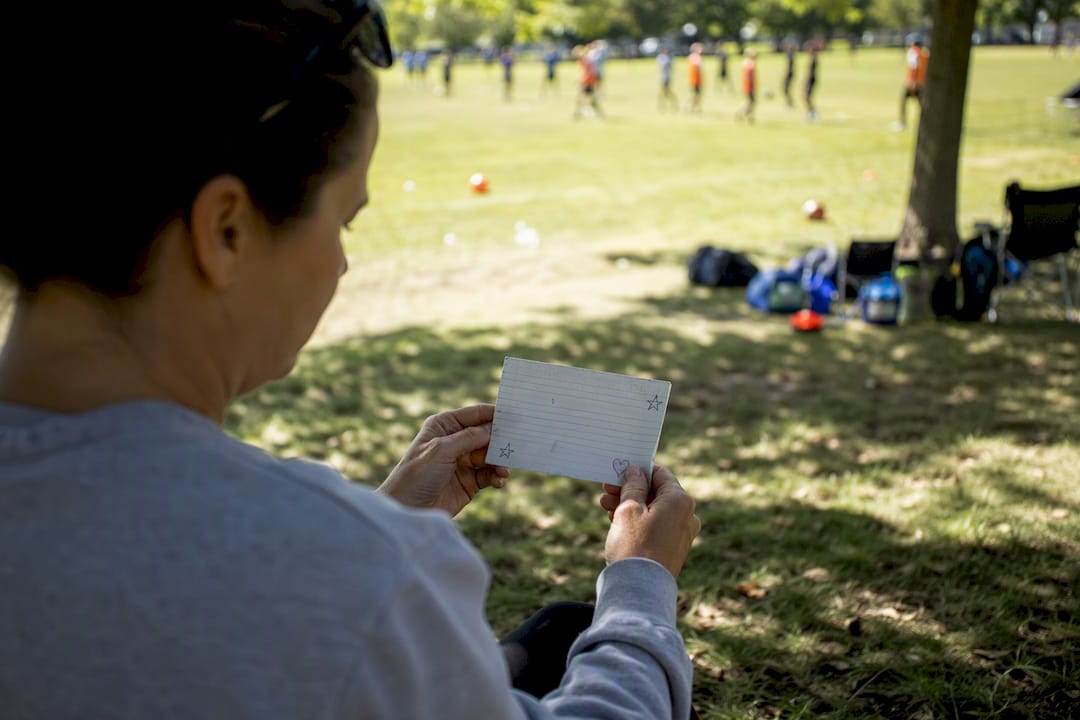
Pro Tip: Write three go-to phrases on an index card and keep it in your car. Something like "I'm proud of how hard you worked" or "What was the best part of today?" Parents freeze under pressure more often than they'd like to admit, and a physical cheat sheet bridges the gap between knowing the principle and actually saying the right thing in the parking lot thirty seconds after a loss.
What Should You Do (and Avoid) on the Sideline and at Home?
The sideline, the car, and the kitchen table are where sports parenting actually happens, not in some abstract philosophy. Here's what the evidence-backed guidance from the Association for Applied Sport Psychology recommends, broken down by setting.
On the sideline:
- Do cheer generically for the whole team, not just your kid.
- Do stay quiet during play. Save the coaching for the actual coach.
- Don't yell instructions, even "helpful" ones. It splits your child's attention and often contradicts what the coach just told them.
- Don't argue with officials. Ever. It's the single fastest way to embarrass a kid in front of their friends.
On the car ride home:
- Do wait for your child to bring up the game first.
- Do try: "That was fun to watch. Want a snack?"
- Don't launch into a play-by-play critique the second the door closes.
- Don't ask "why did you miss that shot" in any tone, ever. It always sounds like an accusation.
At home, later:
- Do let mistakes sit without commentary. Kids process losses on their own timeline.
- Do ask what they're excited about for next practice.
- Don't relive your own playing days as a comparison point. Nobody wants to hear about your travel-ball glory years mid dinner.
- Don't tie allowance, screen time, or mood to game outcomes.
Sideline code of conduct, worth printing and taping to your dashboard:
- Cheer for effort, not just results.
- Never coach from the stands.
- Handle disagreements with officials or coaches after the game, privately.
- Treat every kid on the field like they're yours.
How Do You Talk to Your Child and Their Coach?
Most parent-coach friction comes from timing and tone, not substance. Here's language that tends to work.
Post-game debrief: Skip analysis. Try: "I really liked watching you today. What was your favorite moment?" Let them lead.
When your child wants to quit: Resist the urge to talk them out of it immediately. Try: "Tell me more about what's making you want to stop." Listen fully before responding. Sometimes it's burnout. Sometimes it's a teammate conflict that has nothing to do with the sport itself.
When you have a coach concern: Lead with observation, not accusation. Try: "I noticed [specific behavior] and wanted to understand the thinking behind it." Coaches respond to curiosity far better than complaints.
A short checklist before reaching out to a coach:
- Wait 24 hours after a game before sending any message. Emotions cool fast.
- Request a specific time to talk rather than ambushing them at pickup.
- Bring observations, not conclusions ("He played 4 minutes" beats "You're benching him unfairly").
- Ask one question: what can we work on at home to support the team's approach?
Guidance from a coaches' engagement guide recommends setting these communication norms at the start of the season, not after the first conflict. If a conversation with the coach doesn't resolve things, escalate calmly: request a meeting with an assistant coach present, then loop in a program director only if patterns repeat across multiple games. One rough practice is not a pattern.
What Does Good Involvement Look Like at Each Age?
Involvement that works for a seven-year-old will smother a fifteen-year-old. The 3M framework, which frames the parent's role as Manager, Meaning-Maker, and Model, maps almost perfectly onto these three stages.
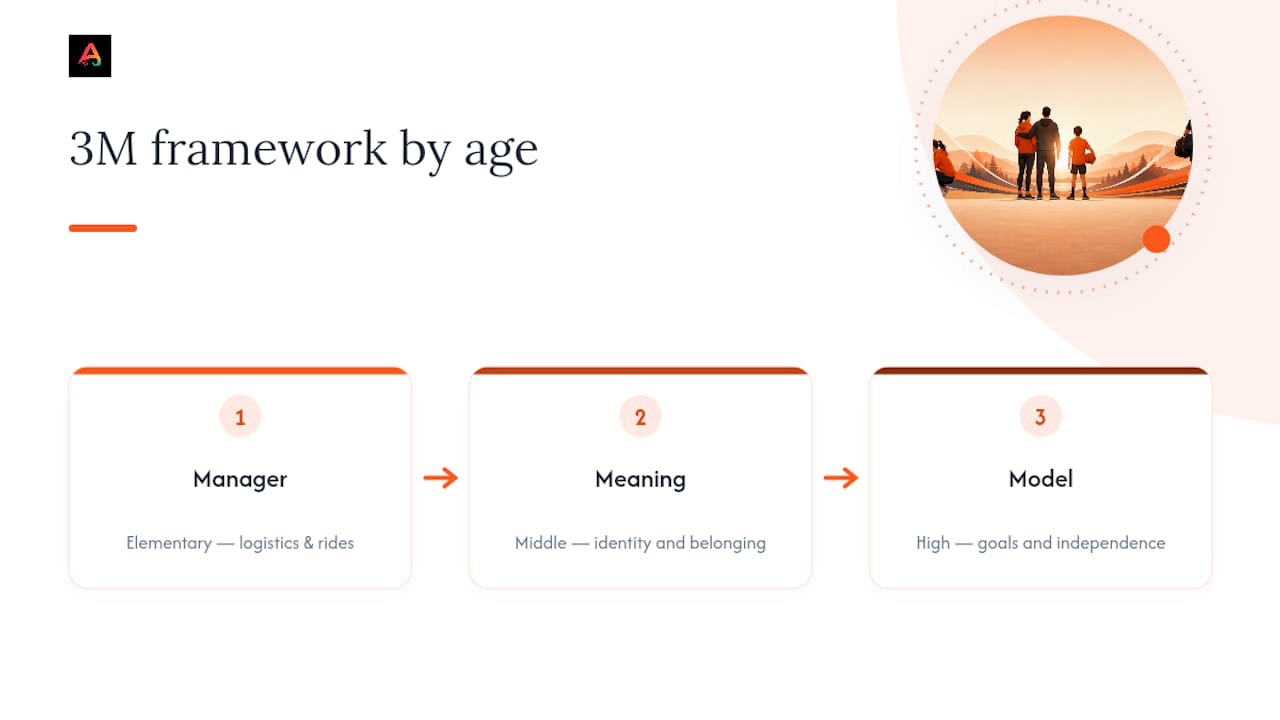
Elementary school (Manager mode): You're handling logistics, gear, snacks, rides. Say: "I packed your favorite water bottle, ready to go?" Common mistake: over-coaching from the driveway before games even start. Kids this age need structure, not tactics.
Middle school (shifting to Meaning-Maker): Kids start caring about identity and belonging. Say: "What do you like most about being on this team?" Common mistake: parents keep managing every detail instead of stepping back, which stalls the athlete's own sense of ownership.
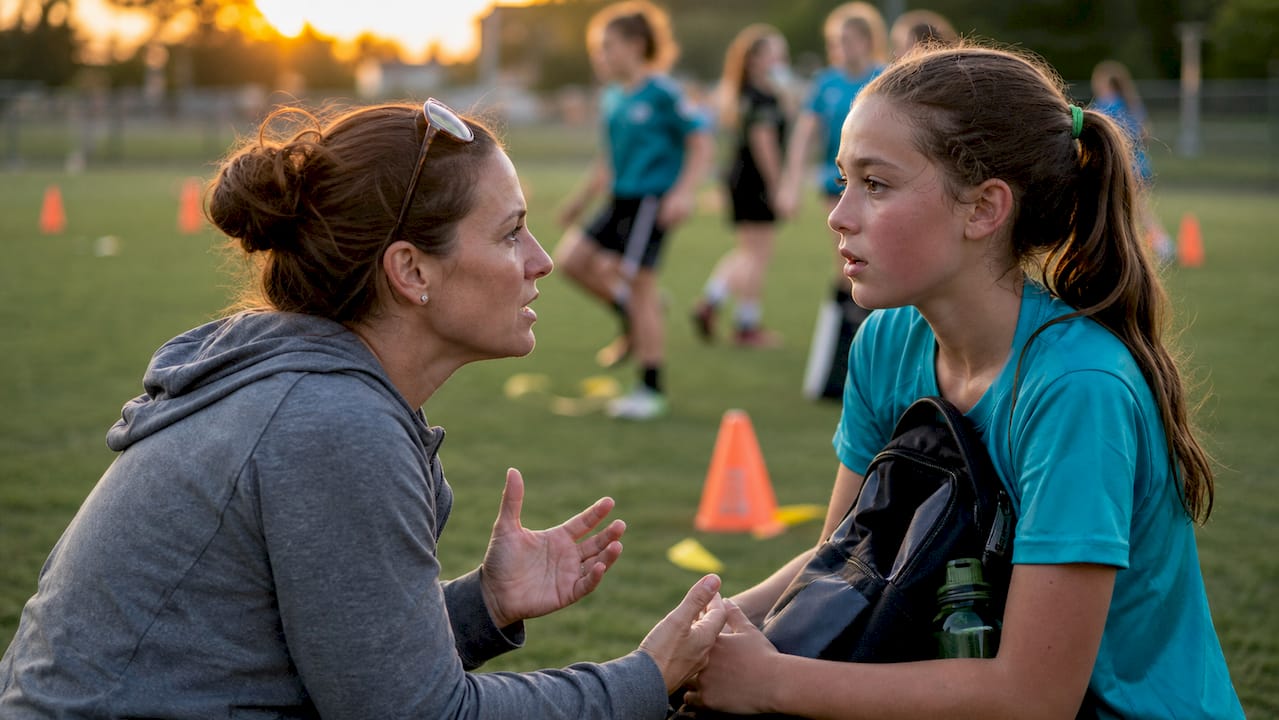
High school (Model mode): Athletes have their own goals, often more sophisticated than yours. Say: "I trust you to handle this with your coach." Common mistake: staying in manager mode too long. A parent still calling coaches about playing time for a sixteen-year-old sends the wrong signal entirely, to the coach and the kid.
The pivot point matters more than people think. Failing to shift roles as a child's skills and independence grow is one of the more common, and more avoidable, causes of teenage disengagement from sport.
What Are the Warning Signs of Burnout, and When Should You Step Back?
Watch for these patterns, not isolated bad days:
- Dread before practice that wasn't there a season ago.
- Physical complaints (stomachaches, headaches) that show up only on game days.
- Withdrawal from teammates or sudden disinterest in a sport they used to talk about constantly.
- Perfectionism spiraling into visible anxiety over minor mistakes.
If you spot two or more of these lasting several weeks, try this order of operations: first, ask open questions and just listen. Second, if nothing shifts, reduce intensity: fewer extra practices, more unstructured play. Third, if the dread persists, support a full break or a switch to a different activity. Practitioner commentary on youth sport is blunt about this: kids need to be allowed to say no, and honoring that boundary usually protects long-term participation better than pushing through.
If things feel bigger than a normal slump, loop in the coach, a sports psychologist, or even a parent coaching program built for exactly these conversations.
Pro Tip: Approach the "step back" conversation with one sentence: "It's okay to take a break. This doesn't have to be forever." Kids often need explicit permission before they'll admit they need it.
How Do You Turn These Principles Into a Weekly Routine?
Principles fade without a routine to hold them. Here's a structure that survives an actual busy week.
- Arrival ritual: One sentence before practice or a game. "Have fun out there" beats any pep talk.
- Mid-week check-in: Ask one open question, unrelated to performance. "What's the best part of practice this week?"
- Post-game reflection: Wait for them to start the conversation. Follow their lead, not your agenda.
This is where the 7-7-7 rule helps. Give yourself 7 seconds of silence after a game before saying anything. Wait 7 minutes before offering any opinion, even a positive one. And limit any actual conversation about the game to 7 sentences, tops. It sounds arbitrary, but the constraint forces you to let your kid process first, which is usually what they need more than your take.
A simple weekly template:
| Day | Ritual |
|---|---|
| Practice days | One-sentence send-off, no post-practice debrief |
| Mid-week | One open, non-performance question |
| Game day | 7-7-7 rule after final whistle |
Printable versions of these scripts and the weekly template appear later in this guide as templates you can screenshot or save.
What's a Simple 3-Step Plan for This Season?
You don't need to overhaul everything by Saturday. Three steps, spread across the season:
- This week: Stop sideline coaching and swap post-game analysis for "I loved watching you play." Immediate, no ramp-up required.
- Next 30 days: Practice the 7-7-7 rule after every game until it's automatic, not something you have to consciously remember.
- End of season: Sit down with your child (and briefly with the coach) and ask how the season felt, not just how it went. Track whether practice attendance stayed steady and whether your kid's mood around the sport improved or declined.
Success here isn't measured in wins. It's measured in whether your kid still wants to play next season, and whether they bring it up on their own.
A Coach and Parent's Honest Take on Getting This Right
One small shift changed everything for a parent I know who also coaches a middle school team: she stopped narrating the drive home. For years she'd ask "What happened on that last play?" the second her son got in the car. One season, she tried silence instead, just letting him talk first if he wanted to. Most days, he didn't say anything about the game at all. He talked about a joke a teammate made, or what he was hungry for. The sport got smaller in the conversation, and somehow he started playing longer, into high school, past the point most of his friends had quit.
This stuff is genuinely hard. Nobody hands you a manual before your kid's first practice, and the instinct to help almost always looks like talking more, not less. Small changes, the ones that feel almost too small to matter, tend to be the ones that stick.
How Athlo Makes Supportive Involvement Easier to Sustain
Good intentions get derailed by logistics more often than by bad parenting instincts. Missed game times, lost medical forms, a coach's message buried in a group text from three teams ago. That friction is exactly where staying calm and supportive gets harder than it needs to be.

Athlo centralizes the parts of youth sports that eat up your mental bandwidth: schedules, coach messaging, medical forms and waivers, and a parental view that shows you what's happening with your kid's team without you having to chase down five different group chats. It also connects to pickup games and local events through LinkUp, so if your athlete just wants to play, finding a game nearby doesn't require you managing another logistics chain. Less scrambling means more energy for the actual job: showing up, staying quiet on the sideline, and asking about the fun part first. Check out Athlo on iOS or Android and see whether it clears space in your week the way it has for other sports families.
Athlo is the alternative to juggling five separate apps and a paper waiver folder for organizing your kid's sports season. It's one hub instead of ten scattered logins.
Sources
- Systematic review: parental influence and motivation in youth sport (2024)
- Perceived parental support vs pressure: links to youth sport enjoyment and amotivation (2013)
- Do’s and don’ts for parents of young athletes — Association for Applied Sport Psychology