
Most families pay somewhere between $100 and $600 a year for recreational youth soccer, $1,500 to $6,000 for competitive travel programs, and $8,000 or more annually once a kid lands on an elite academy or ECNL/MLS NEXT roster, according to USSoccerParent. Three things drive that spread: club dues and registration, tournament travel, and equipment or uniform packages that get pricier as kids move up. Families of youth soccer players spent $910 on average in 2024, up from $537 in 2019, even as participation among 6 to 12 year olds dropped 5.5% between 2013 and 2023. Fewer kids are playing, and the ones who stay are paying more.
Quick reference for what to expect per year:
- Recreational: $100 to $600
- Competitive travel: $1,500 to $6,000
- Elite academy/ECNL/MLS NEXT: $8,000 to $15,000+
Key Takeaways
Youth soccer costs scale directly with travel frequency and competition level, and the biggest overruns come from tournament travel, not club dues.
| Point | Details |
|---|---|
| Know your tier before you commit | Recreational runs $100–$600, travel $1,500–$6,000, and elite/academy $8,000–$15,000+ per year. |
| Budget travel separately from dues | Tournament and travel costs are the most commonly underestimated line item in a season budget. |
| Ask for terms in writing | Confirm refund policy, tournament caps, and what's included before you pay a deposit. |
| Spending is rising as participation falls | Household spend hit $910 in 2024, up from $537 in 2019, while youth participation declined. |
| Use one hub for events and payments | Athlo centralizes event ticketing, QR entry, and secure payments for games and coaching sessions. |
Table of Contents
- What Drives Youth Soccer Costs and Fees Line by Line
- How Youth Soccer Expenses Change by Age and Program Level
- How Families Pay and What to Watch in the Fine Print
- Questions to Ask Before You Commit to a Club
- Tools That Help Parents Track Soccer Payments and Schedules
- Do Youth Soccer Costs Vary by Region?
- Why Household Spending on Youth Soccer Keeps Climbing
- Budgeting Tips to Manage Soccer Expenses All Season
- Youth Soccer Costs and Fees for Parents: What to Expect
- Manage Soccer Payments and Team Communication With Athlo
- Sources
- FAQ
What Drives Youth Soccer Costs and Fees Line by Line
Club dues get the headline attention, but they're rarely the whole bill. A realistic household budget needs to account for kit, travel, and the extras that show up mid-season.
The LevelUp cost breakdown puts mid-tier club totals in the $3,000 to $7,000 range annually, with ECNL and MLS NEXT pathways commonly clearing $8,000 to $15,000. Kit alone deserves its own line: cleats, practice gear, and required uniform replacements often run several hundred dollars a year, separate from whatever the club charges for dues.
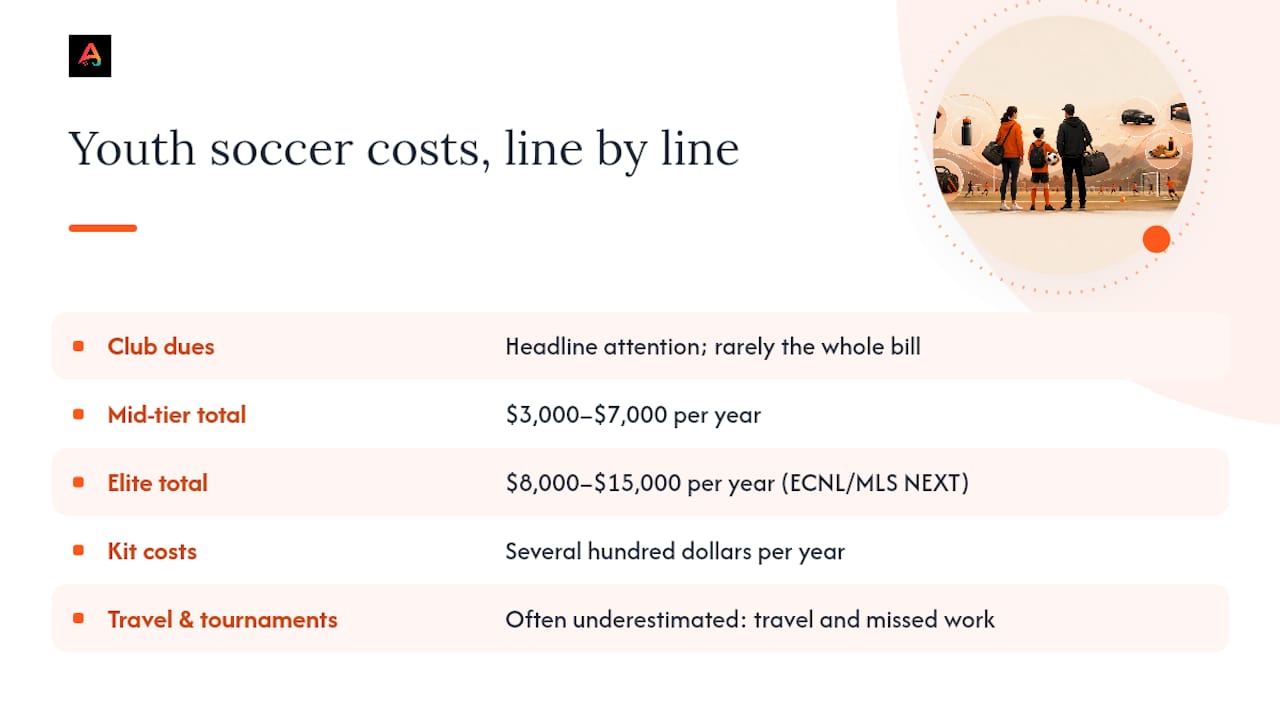
Pro Tip: Parents consistently underestimate tournament and travel costs, not because clubs hide them, but because nobody adds up the hotel nights, gas, meals, and missed workdays until the season's over. Track it as its own line, not an afterthought.

How Youth Soccer Expenses Change by Age and Program Level
The gap between recreational and competitive soccer widens as kids get older, and it's not just about talent. It's about schedule.
- U6–U8 recreational: typically $100–$300/year, one season, minimal travel.
- U9–U12 travel: $1,500–$4,000/year as tryouts, longer seasons, and regional tournaments enter the picture.
- U13+ competitive/academy: $4,000–$15,000/year, driven by showcase events, college recruiting exposure, and multi-state travel.
Costs climb with age mainly because the season stretches longer and the travel radius grows. A U9 travel team might play in-state; a U15 academy squad might fly to three states in a spring. Recruiting showcases starting around U15 add another layer, since many aren't optional if a player wants exposure to college scouts. Spending on youth sports overall rose about 46% between 2019 and 2024, and competitive families feel that increase hardest because their costs compound with every added tournament weekend.
How Families Pay and What to Watch in the Fine Print
Clubs typically offer one of four payment structures: a single seasonal lump sum, a deposit plus monthly installments, a pure monthly plan, or per-tournament billing on top of base dues. Installment plans are the most common for travel clubs because a $4,000 season is a hard ask as one payment.
Before you sign anything, know the refund landscape:
- Deposits are usually nonrefundable, even if your kid gets injured in week two.
- Some clubs auto-charge a card on file for tournament fees without a fresh approval each time.
- Late payments can trigger a "delinquent" hold that benches a player from games until the balance clears.
Checklist to confirm before paying anything:
- What exactly is covered by club dues versus billed separately?
- Is there a cap on the number of tournaments per season?
- Are coach travel expenses passed through to parents?
- What happens to my payment if my child quits or gets injured?
- Is secondary insurance included, or am I covering that myself?
Questions to Ask Before You Commit to a Club
Tryout night is not the time to be shy about money. Ask directly, and get answers in writing when you can.
- "What's included in the base fee, and what gets billed as an add-on later?"
- "How many tournaments do you budget for this season, and roughly how far will we travel?"
- "What's your refund policy if we need to leave mid-season?"
- "Are coaches licensed through United Soccer Coaches or a similar body, and does that affect the fee?"
- "Can I see a full kit cost breakdown before I order?"
Red flags worth taking seriously: vague fee language that dodges specifics, a pattern of "surprise assessments" mid-season, or mandatory training sessions billed outside the regular dues. A club that won't put its tournament schedule and refund policy in writing before you pay is telling you something about how the rest of the season will go.
Tools That Help Parents Track Soccer Payments and Schedules
Between club portals, team group chats, and random Venmo requests, keeping soccer finances straight gets messy fast without a good sports game organizer app. A few tool categories help:
- Payment and escrow apps for handling coach or event payments securely.
- Team-management platforms for rosters, schedules, and availability.
- A simple budgeting spreadsheet that separates fixed dues from variable travel costs.
- Centralized communication and ticketing apps so game info doesn't get buried in five different threads.
Athlo (athloapp.com) fits that last category directly. It centralizes event listings and QR-ticketed entry, and handles secure payments for pickup games or coaching sessions booked through its marketplace, so you're not tracking who owes what across three apps. If your family is juggling a club season plus pickup games or private coaching, it's worth having in one place.
Pro Tip: Screenshot every payment confirmation the moment you pay. Club portals occasionally glitch during high-volume tournament billing weeks, and you want proof if a charge gets disputed later.
Do Youth Soccer Costs Vary by Region?
Yes, and the gap is bigger than most parents expect. Clubs in dense metro areas with high real estate costs, like parts of the Northeast and Southern California, tend to charge more simply because field rental and facility overhead cost more there. A travel club in a major metro might charge $1,000 to $2,000 more per year than a comparable program in a smaller Midwest or Southern city, purely from overhead.
Travel distance compounds regional differences too. Families in less densely populated states often drive farther to reach tournament-level competition, which shows up as gas, hotels, and lost workdays rather than higher club dues. A club in a rural area might have lower base fees but higher effective costs once travel is factored in, while a suburban club near several other strong programs might keep travel short but charge more for facility access.
Field availability plays a role as well. Regions with fewer indoor training facilities often charge premium rates for winter training space, which gets passed to families as a "facility fee" separate from base dues. Before comparing two clubs in different areas by dues alone, ask what a full season actually costs once travel and facility fees are added; the club with the lower sticker price isn't always the cheaper option once you add up the total.

Why Household Spending on Youth Soccer Keeps Climbing
The numbers tell a clear story: families spent $910 on youth soccer in 2024, nearly double the $537 spent in 2019, according to Cronkite News reporting on Aspen Institute Project Play data. More money is chasing fewer players, which is exactly the kind of trend that should make any parent pause before committing to a multi-year travel program.
The increase isn't isolated to soccer. Overall youth sports spending rose roughly 46% between 2019 and 2024, and CNN's reporting captures families describing soccer as a bill they'll prioritize over other household expenses. That's a genuinely uncomfortable trend, and it's worth naming plainly rather than softening it.
Part of the cause is structural. The competitive youth soccer model has shifted toward a year-round, commercialized format with more tournaments and more travel, which pushes costs up across the board. Community-based programs that intentionally limit travel and tournament count tend to hold costs down, which is worth remembering if your goal is development and enjoyment rather than a recruiting pipeline. Not every kid who loves the game needs the $12,000 pathway to get real value from playing.
Budgeting Tips to Manage Soccer Expenses All Season
Treat club dues and variable costs as two separate budget lines from day one. Dues are predictable; tournament travel, gear replacement, and last-minute fees are not, and lumping them together is how families get blindsided in March.
This mirrors advice from LevelUp's breakdown, which recommends separating fixed program dues from variable costs precisely because families tend to underbudget the variable side.
Ask about financial aid early, not after you've committed. Scholarship and reduced-fee programs exist at many clubs, but availability is inconsistent, and documented need submitted before tryouts tends to get better results than a request made mid-season. Organizations like the US Soccer Foundation and community groups such as Soccer Without Borders also run lower-cost programs specifically aimed at removing financial barriers, which is worth investigating if the travel model doesn't fit your budget.
Finally, buy gear off-season when possible, split carpools for tournament travel to cut gas and lodging costs, and revisit your club's payment plan every August before the season locks in. Small adjustments compound over a nine-month season.
Youth Soccer Costs and Fees for Parents: What to Expect
The conventional advice tells parents to "just budget for club dues" and call it done. That's incomplete, and the data backs that up: household spending nearly doubled between 2019 and 2024, and most of that growth came from travel, tournaments, and gear, not the sticker price on a club's registration page. If you're only budgeting the number a club quotes you at tryouts, you're missing the real total by a wide margin.
What actually matters is separating fixed costs from variable ones and asking clubs blunt questions about tournament schedules before you sign anything. Families who get burned aren't usually surprised by dues. They're surprised by the fourth tournament nobody mentioned in March.
Prioritize this first: get a full-season written estimate, including travel, before committing to a competitive program. Everything else, including which tools you use to track payments, matters less than knowing the real number upfront.
Manage Soccer Payments and Team Communication With Athlo
Between club invoices, tournament fees, and side coaching sessions, most soccer parents end up tracking money across four different apps and a group text. Athlo gives you one place instead. It handles secure payments for pickup games and coaching sessions booked through its marketplace, offers QR-ticketed entry for events so you're not digging through email for a confirmation, and keeps your family's sports schedule and communication in a single hub rather than scattered across texts and club portals.

If your kid plays club soccer plus picks up games on the side or works with an outside coach, Athlo (athloapp.com) is built for exactly that overlap. It won't replace your club's billing system, but it will stop you from losing track of the coaching session you paid for last Tuesday or the tournament ticket you bought and can't find. Download Athlo on the App Store or Google Play and set up your first event or coaching payment today.
Sources
- Levelup
- Costs of Youth Soccer: What Parents Should Know
- Rising youth soccer costs, efforts to expand access for underserved
FAQ
How much does youth soccer typically cost?
Recreational programs typically run $100 to $600 a year, competitive travel programs run $1,500 to $6,000, and elite academy or ECNL/MLS NEXT pathways commonly exceed $8,000 to $15,000 annually, according to USSoccerParent.
Is soccer an expensive sport for kids?
It can be, especially at the competitive travel level, where tournament fees, gear, and travel stack on top of club dues. Recreational soccer remains one of the more affordable youth sports options if your family stays at that tier.
How much does it cost to enroll a kid in soccer?
Initial enrollment for recreational soccer usually costs $75 to $400 for registration plus $75 to $200 for basic gear, while enrolling in a competitive travel club can mean an initial deposit plus $1,200 to $3,500 or more in annual dues before travel and tournament costs are added.
Why is US youth soccer so expensive?
Costs have risen due to a year-round, tournament-heavy model that increases travel demands, along with facility fees, licensed coaching staff, and gear that gets replaced every season. Household spending on youth soccer rose to $910 in 2024 from $537 in 2019, even as participation among younger kids declined.