
Every adult with regular, unsupervised contact with kids on your roster needs a background check before they step on the field, and "background check" has to mean a real package, not a $10 name search. The standard is an identity/SSN trace, a multi-jurisdictional criminal database search, county-level criminal records, and a sex-offender registry check, following components NCYS recommends and whatever your sport's national governing body layers on top. Turnaround usually runs 3 to 10 business days. Your next move: write down your screening policy and get every coach cleared before the first practice, not after.
TL;DR:
- A thorough youth coach background check includes identity verification, multi-jurisdictional criminal database searches, county criminal records, sex-offender registry checks, and potentially motor vehicle records if driving is involved.
- Programs must comply with multiple requirements from facilities, state laws, national governing bodies, and insurance policies, often necessitating a layered screening approach before the season begins.
- Checks should be scheduled at least two weeks prior to the first practice to accommodate county record delays, with renewal every one to two years to prevent coverage gaps.
- Flagged records require a documented human review process with clear disqualifying criteria, not automatic exclusion, and must include proper verification, review, and notification procedures.
- Maintaining organized, accessible proof of screening through apps or documents is essential for transparency and compliance, ideally with a written, publicly visible policy.
Table of Contents
- What Does a Youth Coach Background Check Actually Include?
- Where Do Coach Screening Requirements Actually Come From?
- What Should a Youth Coach Screening Policy Cover?
- How Should Programs Handle a Flagged Background Check?
- What Does a Coach Background Check Cost and How Long Does It Take?
- Step-by-Step: Set Up Coach Screening for Your Season
- Using Forms, Waivers, and Coach Profiles to Track Clearance
- An Organizer's Honest Take on Coach Screening
- Another Option for Keeping Coach Documents Organized
- Where to Verify Screening Requirements for Your Program
- Sources
- FAQ
What Does a Youth Coach Background Check Actually Include?
A real coach background check youth programs can rely on is not one search. It's a stack of them, and each one catches something the others miss.
- Identity/SSN trace: confirms the applicant's name, address history, and aliases, which is how the rest of the search knows where to even look.
- Multi-jurisdictional criminal database (MJD): scans records across states quickly, but it's a pointer, not a verified record.
- County criminal search: pulls the actual court record from the county the MJD flagged. Programs run both because MJDs often miss local dispositions that only the county courthouse has.
- Sex-offender registry and federal court search: nonnegotiable for any program with minors.
- Motor vehicle record (MVR): add this if the coach drives kids to away games or tournaments.
If an applicant lived outside the U.S. for six consecutive months in the last seven years, your standard package won't cover that period. USA Track & Field's screening guidance notes those cases need separate international checks or documented proof of foreign clearance, and that adds real time to your timeline. Plan for it early, not the week before tryouts.
Where Do Coach Screening Requirements Actually Come From?
Nobody hands you one rulebook. Screening requirements stack up from several directions at once, and missing one layer is how programs get caught flat.
- Facility or school: many gyms, rec centers, and school districts require their own vendor-approved check or fingerprinting before they'll hand over a key or a field permit.
- State law: some states mandate background checks for anyone coaching minors in organized sports, others leave it to individual leagues. Check your state's childcare or attorney general portal directly rather than trusting a message board.
- Sport national governing bodies: USA Hockey requires background screening for every coach, official, and volunteer with regular athlete contact, and most NGBs, including those under USOPC/SafeSport jurisdiction, run similar mandates.
- Insurance contracts: your league's liability policy may specify screening frequency and vendor requirements as a condition of coverage.
Work this in order: ask your venue or school what they require, check your state's portal, then confirm your sport's NGB and insurance terms. Skipping straight to "we did a background check" without checking all four is how programs end up non-compliant without realizing it.
What Should a Youth Coach Screening Policy Cover?
A written policy is what separates a program that can defend a decision from one that's guessing. Here's what belongs in it:
- Scope: every adult with direct, repeated contact with athletes. That includes assistant coaches, team managers, board members who interact with kids, and any contractor with facility access.
- Frequency: renew regularly, typically every one to two years, and time expiration dates to land before, not during, your season. Aligning checks to season start dates avoids the coverage gap that happens when a clearance quietly expires in week six.
- Data handling: get signed consent, store results securely, limit access to whoever adjudicates, and publish a plain-language statement to parents explaining what you screen for and how often.
Pro Tip: Post your screening policy somewhere parents can actually find it, like a team handbook or your registration page. A visible policy answers the "did you check this guy out" question before a parent has to ask it.
How Should Programs Handle a Flagged Background Check?
"Flagged" doesn't mean "disqualified." It means a human has to look at the record before anyone makes a call, and NCYS guidance is explicit that a documented review process, not automatic exclusion, is the standard.
- Verify the record is actually the applicant's, not a name match error, which happens more than people expect.
- Route it to a small review panel, not one administrator making a solo call.
- Set clear disqualifying criteria ahead of time (violent offenses, sex offenses, crimes against children) and note where mitigating factors like age at offense or time elapsed apply.
- If you deny or remove someone based on the result, follow adverse-action notification steps and keep a paper trail. That documentation protects the kid and the program if the decision is ever challenged.
What Does a Coach Background Check Cost and How Long Does It Take?
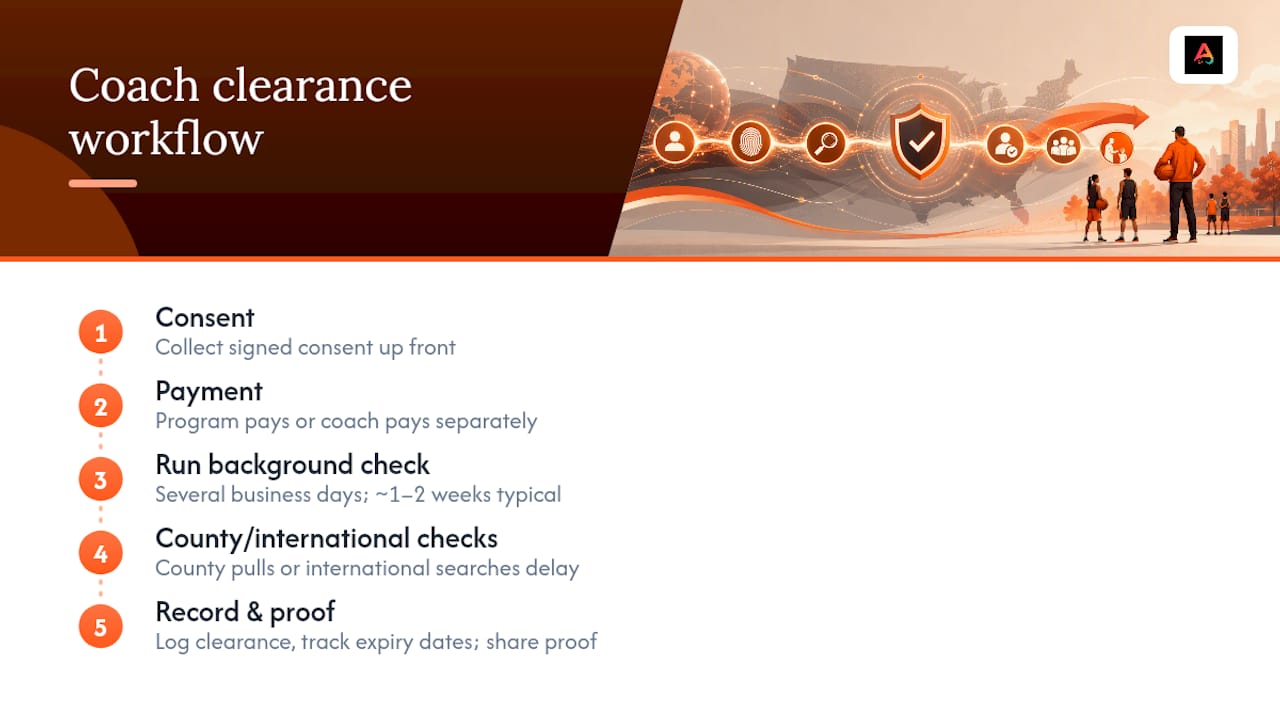
Budget realistically or you'll be scrambling the week before opening day. Standard U.S. background checks typically return results in several business days, often within about a week or two., with county-record pulls and international searches adding the most delay.
Most youth sports packages run in the range vendors quote for standard multi-search bundles, with MVR and international add-ons priced separately. Some programs cover the cost as part of registration fees; others pass it to the coach or volunteer directly. Either way, collect signed consent up front and keep a simple record, even a shared spreadsheet, showing which coaches are cleared and when their check expires, so you can hand parents proof without digging through email threads.
Step-by-Step: Set Up Coach Screening for Your Season
Getting from "we should probably do background checks" to an actual working system takes a handful of concrete steps.
- Draft and publish your policy. Cover scope, frequency, and adjudication, and post it where parents and staff can see it.
- Pick a provider and build your consent form. Confirm the package includes the core searches, and add MVR or international checks for anyone who drives kids or lived abroad recently.
- Schedule checks before practice starts. Build in buffer time for county searches, since those often run longer than the standard database pull.
- Set renewal reminders now, tied to your season calendar, not a generic "one year from today" date.
- Show parents proof. A simple cleared/not-cleared status per coach goes a long way toward trust.
Pro Tip: Run your background checks two weeks before your first practice, not two days. County records are the slowest piece, and they're the one you can't skip.
Using Forms, Waivers, and Coach Profiles to Track Clearance
Once checks are done, the real headache is proving it to parents without a paper folder. Some apps let organizers hold medical forms, waivers, and coach profile info in one place, so a coach's clearance status sits next to their bio instead of buried in email. It's an organizational layer for your existing screening process, not a screening vendor itself.
An Organizer's Honest Take on Coach Screening
The programs that get this right don't have fancier vendors. They have a deadline that lands two weeks before the first practice, every single season, and a written policy nobody has to improvise. That's the whole trick.
— Abdulazeez
Another Option for Keeping Coach Documents Organized
Once your screening policy is set, the next headache is usually logistics: where do the forms live, and how do parents actually see proof? Athlo is built for exactly that gap. Organizers use it to centralize medical forms and waivers, publish coach profiles through the coaching marketplace, and give parents one place to check that a coach's paperwork is current instead of chasing PDFs by text.

If you're running a league or club and tired of tracking clearance status across five different spreadsheets, this is worth a look. Programs also use Athlo's pickup game and event tools to keep rosters and documents connected in one hub, whether it's a weekly rec league or a full travel season. Download Athlo on the App Store or Google Play and set up your first coach profile before your next registration cycle opens.
Where to Verify Screening Requirements for Your Program
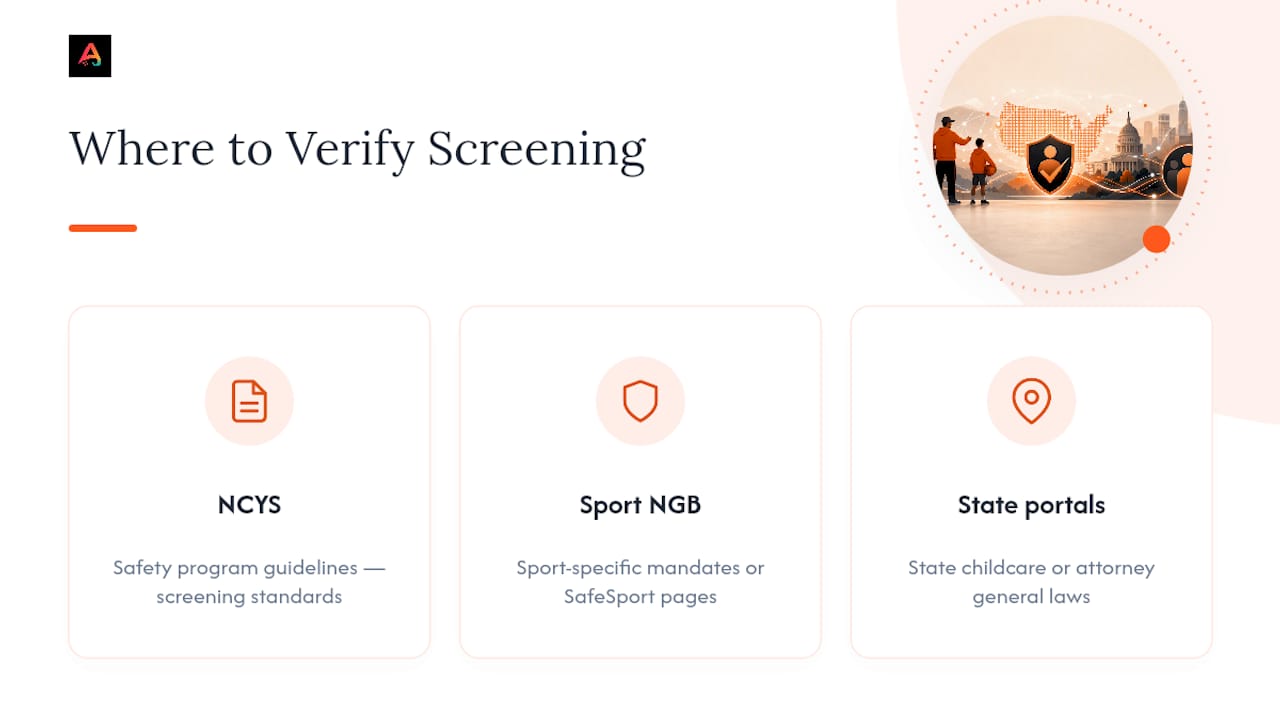
Check NCYS's safety program guidelines for screening standards, your sport's NGB or SafeSport page for sport-specific mandates, and your state's childcare or attorney general portal for state law.
Sources
- How long do background checks take? | GoodHire
- NCYS Guidelines: Build a Safety Program
- Background screening | USA Hockey
- The Enforceability of Liability Waivers (Vanderbilt Law Review excerpt)
FAQ
Can Someone With a Felony Coach Youth Sports?
It depends on the offense, how long ago it occurred, and your state and NGB rules. Violent crimes, sex offenses, and crimes against children are near-universal disqualifiers, while older, unrelated felonies are sometimes evaluated case by case under a documented review process.
How Far Back Do Coaching Background Checks Go?
Standard county criminal searches typically cover up to seven years, per NCYS guidance, though sex-offender registry checks and some NGB requirements aren't limited by a lookback window at all.
Why Do Youth Sports Programs Require Background Checks for Coaches?
Because a signed waiver doesn't screen out dangerous adults. Waivers mainly limit liability for accidents, and courts frequently limit their enforceability for minors, so screening is the actual safeguard, not the paperwork.
Do 16-Year-Old Assistant Coaches Need a Background Check?
Most youth sports policies focus screening on adults 18 and older with regular contact with athletes, so minors usually fall outside standard requirements. Check your specific state law and sport NGB policy, since some leagues still require supervision protocols for underage helpers even without a formal check.
Are Fingerprint-Based Checks Different From Standard Screening Packages?
Yes. Fingerprint checks run against FBI and state repository databases and are sometimes required by schools or state law on top of a standard commercial screening package, not instead of it.