
The single best way to prevent ticket fraud in sports is to buy only from official sellers or a verified in-app transfer, pay with a credit card, and refuse screenshots as proof of purchase. If a seller pushes you toward Venmo, Zelle, or a wire transfer, walk away. Insist the ticket lands in your account or wallet before you send a dime.
TL;DR:
- Only buy tickets from official venues, team websites, or authorized resale platforms that offer verified digital transfers to prevent static QR code fraud.
- Use a credit card for payments, as it provides dispute rights, unlike peer-to-peer apps or wire transfers, which leave no recourse once the money clears.
- Demand tickets be transferred into your account or wallet directly, and avoid accepting screenshots or static images as proof of purchase.
- Recognize common scam patterns such as speculative ticket listings, asking to move conversations off-platform, or suspiciously low prices for sold-out events.
- Immediately report any scam by saving all evidence, contacting your card issuer for a chargeback, and filing complaints with FTC, FBI IC3, or your state attorney general.
Table of Contents
- Quick Checklist to Prevent Ticket Fraud at the Point of Sale
- How Do Ticket Scams Actually Work?
- Where Should You Actually Buy Tickets?
- How Do You Verify a Digital Ticket Before Game Day?
- What Can Organizers Do to Cut Down on Fraud?
- What Should You Do Immediately After a Scam?
- How Athlo Handles Ticketing for Youth and High School Games
- A Closing Note on Trading Convenience for Verification
- Get Secure Ticketing Without the Screenshot Guesswork
- Sources
- FAQ
Quick Checklist to Prevent Ticket Fraud at the Point of Sale
Most sports ticket scams get caught with one habit: pausing for ten seconds before you pay. Here's what to check every single time, whether you're buying from a stranger on social media or a reseller you've never used before.
- Type the venue or team's URL into your browser yourself. Don't click a link from a text, DM, or sponsored ad, since typosquatted domains are built to look identical to the real thing.
- Pay by credit card or through an official escrow system built into the platform. Never send money through Venmo, Zelle, Cash App, a wire transfer, or gift cards, all of which are close to impossible to claw back.
- Never accept a screenshot as your ticket. Demand an official transfer into your account, your wallet app, or a mobile ticket with your name attached.
- Be suspicious the moment a seller wants to move the conversation to WhatsApp or text. Ask for a phone call or ID verification if something feels off.
- If the ticket fails to scan at the gate, take a photo or video of the error message on the scanner immediately. That's your evidence if you need to dispute the charge later.
Pro Tip: Screenshot the seller's profile, listing, and any messages before you pay, not after. Scammers delete accounts fast once the money clears, and a saved screenshot on your end is often the only record left.
How Do Ticket Scams Actually Work?
Fraud follows a handful of repeatable patterns, and once you recognize them, they get a lot easier to spot in the wild.
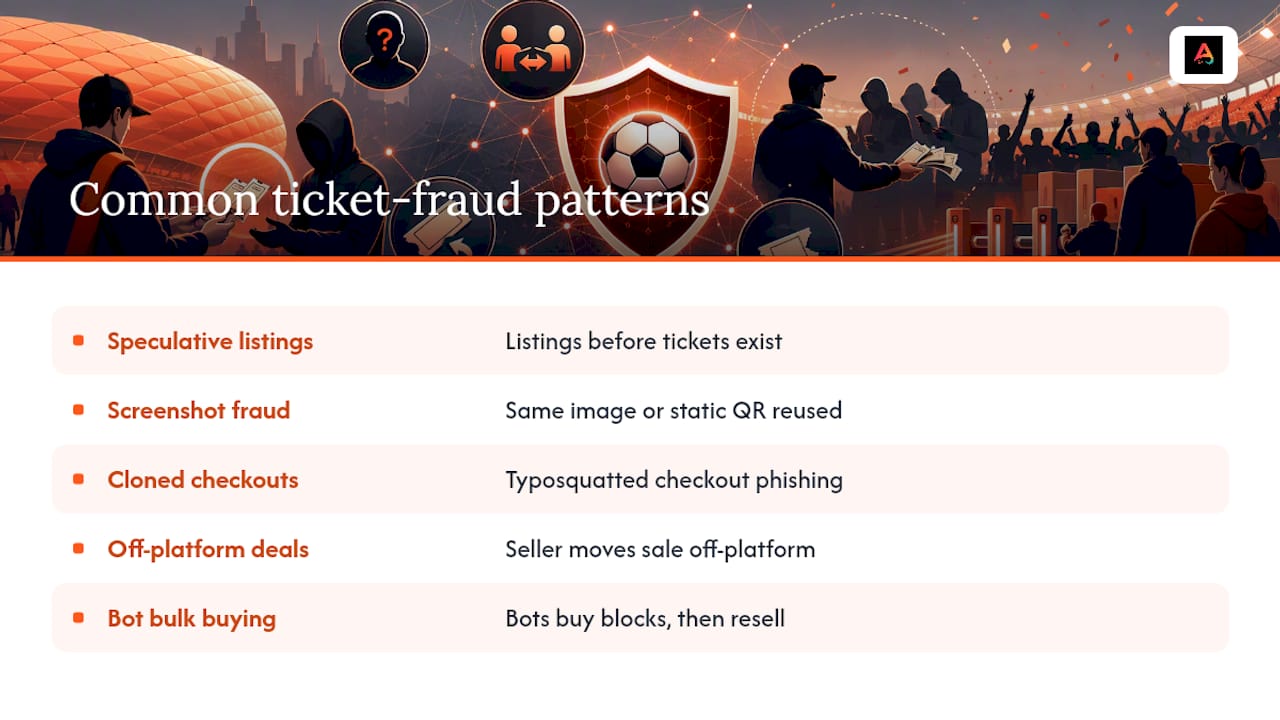
Speculative ticketing is one of the sneakiest. A seller lists tickets to a game before inventory even exists, betting they can source real ones later, or just planning to vanish after payment clears. Fake "pre-release" waiting lists work the same way. They manufacture urgency for an event that hasn't gone on sale yet.
Screenshot fraud is the most common trick at the amateur level. A scammer sells the same screenshot of a ticket to five different buyers, or reuses a static QR code that can't actually be validated more than once. Legitimate mobile tickets use rotating or dynamic barcodes precisely because a static code is trivial to duplicate.
Cloned checkout pages show up through typosquatted URLs, ones that swap a letter or add a hyphen to a real team or venue domain. You think you're buying from the box office. You're actually handing your card number to a phishing site.
Then there's the platform-hopping move. A listing shows up on a legitimate marketplace or social media post, looks completely normal, and then the seller asks to "finish the deal" over WhatsApp or direct message. The Attorney General's office has repeatedly warned that moving off-platform is one of the clearest signals of a scam in progress, since it strips away any buyer protection the original platform offered.
Bot-driven bulk buying feeds a lot of this from the top. Bots snap up large blocks of inventory the second it drops, then dump it into unauthorized resale channels at inflated prices, which is exactly the kind of activity that ends up in front of federal lawmakers examining bot resales and their effect on ticket buyers.
Where Should You Actually Buy Tickets?
Stick to three channels: the venue or team's own box office, the official team or league website, and authorized resale marketplaces that offer a verified transfer feature. All three give you a paper trail if something goes wrong.
Payment method matters almost as much as the seller. A credit card gives you a dispute process built into federal consumer protection law. The FCC has flagged that as peer-to-peer payment apps have grown more popular, scammers have followed the money, because those apps treat every transfer as a personal gift with no built-in recourse. Wire a stranger $400 for football tickets and that money is gone the second it clears. Put it on a credit card and you have a shot at reversing the charge.
By the numbers: Credit card networks operate formal chargeback and dispute systems specifically because peer-to-peer transfers, wires, and gift cards generally don't, which is why the FCC calls out payment apps by name as a growing target for scammers riding the shift away from cash.
On resale listings, a few red flags should stop you before you check out:
- A price that's dramatically below face value for a sold-out game, especially courtside or front-row seats.
- A seller who refuses a phone call or won't answer basic questions about section, row, or how they got the tickets.
- Pressure to complete the purchase within minutes "before someone else grabs it."
- No official transfer option, just a promise to "send the ticket after payment."
Whenever the platform offers an in-app transfer feature, use it instead of a person-to-person handoff. That transfer creates a digital record tying the ticket to your account, which is exactly what protects you if the original buyer tries to resell the same seat twice.
How Do You Verify a Digital Ticket Before Game Day?
A screenshot tells you nothing about whether a ticket will actually scan. Legitimate mobile tickets use rotating or account-bound codes that refresh periodically, precisely so a static image can't be copied and resold to multiple people. If a seller sends you a plain screenshot and calls it done, that's your answer right there.
Here's the verification sequence worth running every time:
- Ask how the transfer will happen. A legitimate seller can move the ticket into your account through the platform's official transfer tool, not a text message with an attached image.
- Check the QR code's destination carefully. If you're asked to scan a code sent through a random link before you've even paid, don't. That's a phishing setup, not a ticket.
- Request proof of original issuance, like the confirmation email or order number from the primary seller, which is much harder to fake convincingly than a cropped screenshot.
- Confirm the ticket lands in your name or account before final payment clears, whenever the platform allows staged verification.
- At the gate, have your confirmation email and payment receipt ready in case the scanner throws an error. Staff typically need something beyond the ticket screen itself to sort out a transfer mismatch on the spot.
Pro Tip: If a scan fails at the gate, don't just walk away frustrated. Get a photo or video of the actual error screen on the scanner before you leave the line. That single piece of evidence is often what separates a successful chargeback from a denied one.
For a closer look at how mobile scanning actually behaves at the door, including what staff can and can't fix on the spot, see this breakdown of mobile ticket scanning.
What Can Organizers Do to Cut Down on Fraud?
If you're running youth games, high school matchups, or any ticketed local event, the fraud problem isn't abstract. It shows up as angry parents at your gate holding a screenshot that won't scan.
A few controls make an outsized difference:
- Bind tickets to accounts, not screenshots. Rotating or encrypted barcodes that refresh on a schedule are far harder to duplicate than a static QR image, a point industry security guidance has made repeatedly around fan account protection.
- Limit per-account purchases and watch for unusual purchase velocity, like the same card buying a dozen tickets in ninety seconds. That pattern almost always signals bot activity rather than a real family buying seats.
- Deploy basic bot protections at onsale, even something as simple as a CAPTCHA or a purchase limit, since bulk bot buying is exactly what feeds unauthorized resale markets according to Senate Commerce Committee testimony on the topic.
- Offer one clearly labeled resale or transfer channel with explicit rules, so fans aren't left guessing whether a third-party listing is legitimate.
- Train gate staff on transfer mismatches. Give them a simple process to verify a buyer's identity and capture evidence, like a photo of the failed scan, instead of just turning people away.
Identity verification embedded into the ticket itself, tying a seat to a real account rather than a transferable file, is increasingly the practical long-term fix organizers are leaning on. It's not friction for friction's sake. It's the difference between a gate that runs smoothly and one where three families show up holding the same seat number.
What Should You Do Immediately After a Scam?
Speed matters here. The sooner you act, the better your odds of getting your money back.
- Save everything. Screenshot the original listing, every message with the seller, your payment receipt, and any photo or video of a failed gate scan. This is your evidence file.
- Contact your card issuer right away to start a dispute or chargeback. Card issuers generally have windows for filing a claim, and the sooner you report it, the stronger your case.
- File a report with the FTC at Reportfraud. This doesn't get your money back directly, but it feeds a database investigators actually use.
- Report internet-based fraud to the FBI's Internet Crime Complaint Center (IC3), especially if the scam involved a phishing link or fake checkout page.
- Contact your state attorney general's office, since several AG offices actively track and warn about ticket scams tied to specific teams and seasons.
Documentation like a video of the gate error message paired with your original receipt is often the deciding factor in whether a chargeback succeeds. Chargebacks can take anywhere from a few weeks to a couple of months to resolve, so file early and follow up.
How Athlo Handles Ticketing for Youth and High School Games
Most youth and high school ticket fraud isn't sophisticated. It's a parent forwarding a screenshot to another parent, or a gate volunteer waving people through because the line is backed up and nobody can verify anything fast enough.
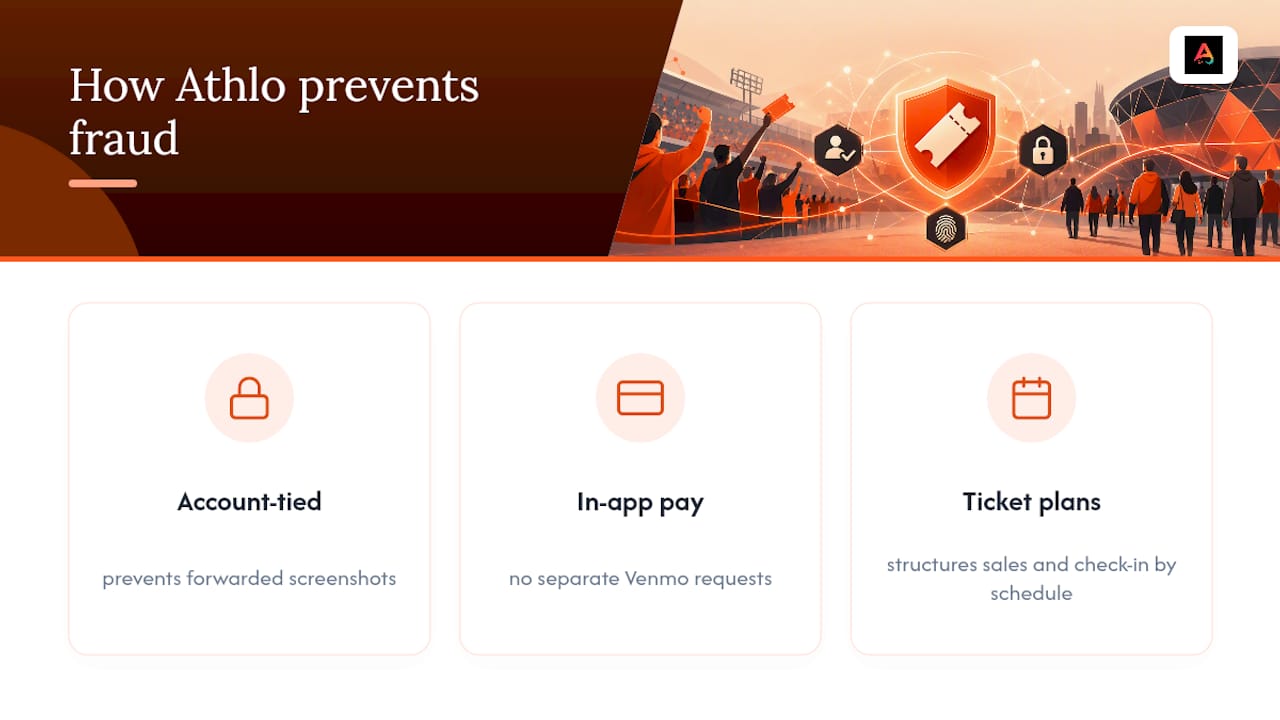
Tickets are kept tied to a buyer's account rather than a forwardable image, with QR check-in and in-app payments built into the same flow. Organizers running a season or a single tournament weekend can set up ticket plans that structure sales and check-in around the actual schedule, which cuts down on the gate-line chaos that makes duplicate tickets easy to miss in the first place. Because payment and ticket issuance happen inside the same app, there is no separate Venmo request floating around and no screenshot standing in for a real ticket. For local organizers trying to run a tighter gate without hiring extra security, that's a meaningful reduction in the two biggest fraud vectors amateur events actually face.
A Closing Note on Trading Convenience for Verification
Fans want tickets fast, and organizers want lines that move. Both instincts fight against fraud prevention, which almost always asks for one extra step: verify the seller, wait for the official transfer, pay with a card instead of cash-app convenience. That friction is annoying. It's also the entire reason chargebacks and disputes exist as a safety net.
Organizers running local games face a real tradeoff too. Add too much verification and you frustrate families standing in line before kickoff. Add too little and someone's teenager gets turned away from a game they paid for. The right balance leans toward more friction than feels comfortable, paired with clear communication about why it's there.
Preserve your evidence, use the official reporting channels, and don't assume a scam this small isn't worth reporting. It is, and the aggregated reports are exactly what help agencies spot a pattern before more people get scammed.
— Abdulazeez
Get Secure Ticketing Without the Screenshot Guesswork
Athlo is the alternative to screenshot-and-hope ticketing for youth and high school games: tickets stay bound to a buyer's account, check-in runs through QR scanning, and payment happens in the same app instead of a separate Venmo request nobody can trace later.
For local organizers, that means fewer duplicate tickets at the gate and a lot less time spent untangling who actually paid for what. For parents and players, it means a ticket that can't be forwarded five times and resold to strangers. Athlo's event ticketing with QR check-in handles the transfer and validation piece directly, and the same app covers team payments for coaching sessions and pickup games without routing money through apps that offer no dispute process.
If you're running games this season, or just tired of chasing down payment screenshots from other parents, download Athlo on the App Store or Google Play and set up your first event through Athloapp.
Sources
- FCC: More consumers adopt payment apps — scammers follow
- AG Sunday warns of ticket scams as Flyers, Penguins, and 76ers begin post-season
- Reportfraud
- IC3 — Internet Crime Complaint Center
FAQ
How Do I Prevent Ticket Fraud Before I Buy?
Buy only from official sellers, team pages, or verified resale marketplaces, pay by credit card, and never accept a screenshot in place of an actual ticket transfer.
What Will a Legitimate Seller or Bank Never Ask You to Do?
A legitimate ticket seller will never ask you to wire money, pay with gift cards, or move your conversation to a private messaging app to "finish the deal," and your bank will never ask for your full card number or PIN over text or email.
Is Ticket Scalping Still Illegal?
Scalping laws vary by state and mostly regulate resale price caps and bot use rather than banning resale outright, so check your specific state's rules before assuming a resale is automatically illegal.
How Do I Avoid Getting Scammed Buying Tickets Online?
Type the seller's URL in yourself, verify identity before paying, use a credit card instead of peer-to-peer apps, and insist on an official transfer into your account rather than a screenshot.
Where Do I Report a Ticket Scam?
Report it to your card issuer for a dispute, file with the FTC at Reportfraud, submit a complaint to the FBI's IC3, and notify your state attorney general's office.