
When a kid takes a hit and something seems off, the protocol is simple: pull them out immediately, get a licensed evaluation, don't let them back on the field that day no matter how "fine" they insist they are, and follow a documented, clinician-supervised 6-step return-to-play plan with a full day between each step. Everything else in youth concussion management is detail supporting that one sequence.
TL;DR:
- Most states require immediate removal from play and written clearance from a licensed provider before a youth athlete can return to sports.
- The six-step return-to-play process must be spaced at least 24 hours apart, with no progression if symptoms return on a given day.
- Being symptom-free at each stage and completing return-to-learn accommodations are essential before full participation resumes.
- Documentation should include detailed incident notes, timely parent notification, and clinician clearance, preferably managed with digital tools like Athlo.
- Coaches must undergo concussion training and follow prevention protocols, but only licensed health care providers can clear athletes to return.
Table of Contents
- What Concussion Protocol Youth Sports Rules Actually Require on the Sideline
- Recognizing Concussion Symptoms in the First 72 Hours
- Removal, Medical Evaluation, and What State Law Requires
- The 6-Step Return-to-Play Progression, Explained
- Return-to-Learn: Why School Comes Before the Field
- Documentation That Actually Holds Up: What to Record and Who Gets It
- Building a Concussion-Safe Program: Training, Rules, and Culture
- Your Printable Sideline Checklist and Sample Form Language
- How Athlo Fits Into a Team's Concussion Documentation
- What I Learned Watching a Youth Team Handle This Right
- Get Concussion Documentation Out of the Glove Compartment
- Sources
- FAQ
What Concussion Protocol Youth Sports Rules Actually Require on the Sideline
The first ninety seconds after a hard hit decide everything that follows. Get this part wrong and you're not just risking a longer recovery, you're potentially breaking state law.
Here's the sequence that matters:
- Stop play immediately. Whistle it dead the moment you suspect a head injury, even if the athlete is begging to stay in.
- Check for emergency red flags first. Loss of consciousness, worsening headache, repeated vomiting, slurred speech, seizure, weakness or numbness in the arms or legs, or a kid who can't be woken up means you call 911. Do not move an athlete with a suspected neck or spine injury.
- Remove the athlete from the field of play. Not the bench, not "just sit for a play." Off the field, out of the game, done for the day.
- Do a brief sideline check. Ask their name, the date, what happened right before the hit, and what quarter or inning it is. Watch their balance. Look at their pupils. You're not diagnosing, you're gathering information for whoever evaluates them next.
- Watch them for at least 15 to 20 minutes, since some symptoms take a few minutes to show up after adrenaline drops.
- Notify the parent or guardian right away, by phone if you can reach them, not a text sent after practice wraps.
- Write down what you saw, including the time of injury, the mechanism, and every symptom reported, while it's still fresh.
Certified athletic trainers, where a program has one on staff or on contract, are trained to run a more structured sideline assessment using tools like the Child SCAT5, which typically takes at least 10 minutes of quiet space to administer properly, according to guidance from the American Academy of Pediatrics. Most youth leagues don't have that resource on the sideline, which is exactly why the fallback rule exists: when a certified professional isn't available to clear the athlete, you treat it as a concussion and sit them out.
Pro Tip: Keep a laminated card in your coach's bag with the emergency red-flag list and your league's emergency action plan phone tree. In the adrenaline of the moment, even veteran coaches forget steps they'd never miss on a quiz.
The mantra you'll hear from every athletic trainer, physician, and concussion specialist is the same: when in doubt, sit them out. It's not just a slogan, it's the legal and clinical default position every state has built its youth sports laws around.
Recognizing Concussion Symptoms in the First 72 Hours
A concussion doesn't always look like a concussion. Some kids stagger. Most don't.
Symptoms fall into four buckets, and a young athlete rarely shows all of them at once:
- Physical: headache, dizziness, nausea or vomiting, sensitivity to light or noise, blurred vision, balance problems, feeling "foggy" or slowed down
- Cognitive: difficulty concentrating, trouble remembering new information, confusion about assignments or plays, feeling mentally "fuzzy"
- Emotional: irritability, sadness, unusual nervousness, being "more emotional" than normal
- Sleep-related: drowsiness during the day, sleeping more or less than usual, trouble falling asleep
Younger athletes, especially those under 12, often can't articulate what's wrong. They won't say "I feel foggy." They'll just seem clingy, cranky, or unusually quiet, or they'll ask to sit out something they normally love. Parents and coaches of younger kids need to watch behavior changes as closely as they'd listen for verbal complaints. Teenagers tend to self-report more accurately, but they're also far more likely to downplay symptoms because they don't want to lose their starting spot or let the team down. That's a bigger risk factor than most coaches realize.
Symptoms evolve. A kid who seems mostly fine on the sideline can wake up the next morning with a pounding headache, or develop sleep problems two days later that weren't there initially. That's why the initial sideline check is never the final word. Medical guidance for youth athletes leans conservative here: children and adolescents often take longer to recover than adults, and evaluation should account for that instead of using adult recovery timelines as a benchmark, according to a sport-related concussion review published on PMC. If new symptoms show up or existing ones get worse in the 72 hours after injury, that's a reason to go back to the clinician, not wait out the week and hope.
Removal, Medical Evaluation, and What State Law Requires
This is the part where "common sense" and "legal requirement" happen to line up perfectly. Every U.S. state and the District of Columbia has enacted a youth concussion law, and they generally require the same two things: immediate removal from play when a concussion is suspected, and no return that same day, according to a review of youth-concussion laws across the nation. That's not a patchwork of rules where some states are stricter than others on the basics. The floor is the same everywhere.
Where states differ is in the details of who can clear an athlete to return and what that clearance has to look like on paper:
- Most states require evaluation and written clearance from a licensed health care provider before an athlete can resume any physical participation.
- Which providers qualify varies. Some states accept clearance only from physicians; others include nurse practitioners, physician assistants, or athletic trainers working under a physician's supervision.
- Many states mandate annual concussion education for coaches before they're allowed to coach a season.
- Some states require a signed acknowledgment form from parents at the start of each season confirming they've received concussion information.
States also provide, or require leagues to use, standardized clearance paperwork. Ohio's medical clearance form requires a licensed provider to sign off before return to play, tying that clearance directly to completion of a graduated return protocol. Massachusetts takes a similar approach with its post sports-related head injury medical clearance form, which explicitly links academic readiness to the clearance decision. If your league or school doesn't already have a state-approved form on file, that's a compliance gap worth fixing before the season starts, not after an incident.
National youth organizations back this up with their own guidance. Little League recommends immediate removal, licensed medical clearance, and annual concussion education as baseline policy for every program under its umbrella, regardless of which state a league operates in. If you're organizing a rec league or travel team and you're not sure what your state requires, those are the first resources worth checking, alongside your state's department of health website.
One more thing worth saying plainly: coaches and volunteer administrators are not qualified to clear an athlete to return, full stop. Even a coach with years of experience watching sports injuries is not a substitute for a licensed evaluation. That's not a knock on coaching judgment, it's just not the coach's job, and state law generally doesn't allow it to be.
The 6-Step Return-to-Play Progression, Explained
Once a licensed provider has cleared an athlete to begin the return process, the actual comeback isn't a light switch, it's a ladder. The standard graduated return-to-play progression used across concussion guidelines has six steps, and the CDC's HEADS UP guidance recommends at least 24 hours between each one.
Here's what each stage typically looks like in practice:
- Back to regular activities. School, work, and normal daily routines, with no exercise yet. The goal is confirming the athlete can handle normal cognitive demands symptom-free.
- Light aerobic activity. Walking or light stationary biking for 10 to 15 minutes, keeping the heart rate low. No weightlifting, no head impact.
- Moderate activity. Running drills, moderate-intensity biking, or brief resistance training. Still no contact.
- Heavy, non-contact activity. Sport-specific drills at closer to game intensity, harder cardio, and near-regular resistance training, but no drills involving contact or risk of head impact.
- Practice and full contact. Normal training activities, including full-contact practice, once cleared by a licensed health care provider.
- Return to competition. Full participation in games, with no restrictions, following a green light through every prior step.
The rule that separates a real protocol from a wishful one is simple: no advancement on a day where symptoms return. If a headache shows up at stage 3, the athlete drops back to the last symptom-free stage, rests at least 24 hours, and tries again before moving forward. This isn't optional caution, it's the whole point of the progression. Medical guidance for children and adolescents leans even more conservative than the adult version of this same protocol, since younger athletes often take longer to recover fully and return-to-learn needs to factor into the sequencing, per the PMC concussion management review.
Here's the number that should worry every coach and parent reading this: studies estimate 10% to 38% of young athletes return to play the same day as their concussion, despite laws in all 50 states prohibiting exactly that. That gap between what the law says and what actually happens on fields and courts across the country isn't a documentation problem, it's a culture problem, usually driven by pressure to not let the team down or a parent's instinct to not overreact to "just a bump."
If an athlete regresses more than once through the six stages, or if headaches, dizziness, or cognitive symptoms persist beyond two to three weeks, that's a signal to go back to the clinician for re-evaluation rather than push through on the same timeline. Persistent symptoms, sometimes called post-concussion syndrome, need a different management plan than a straightforward recovery, and pushing a stalled progression usually backfires.
Return-to-Learn: Why School Comes Before the Field
Most youth sports conversations skip straight to when a kid can play again. That's backwards. The more clinically accurate question is when a kid can learn again, because academic recovery is generally a precondition for physical recovery, not a parallel track.
Full academic function without accommodations is typically required before starting the physical return-to-play steps, according to concussion research linking academic recovery to safe RTP timing. Massachusetts's clearance form makes this explicit, requiring return to school without accommodations before a gradual return-to-play plan even begins.
Common classroom accommodations during recovery include:
- Shortened school days or a later start time
- Extra time on tests and reduced homework load
- Breaks during the day in a quiet space
- Reduced screen time and limited reading load
- Excused absence from noisy environments like the cafeteria or gym class
A school nurse, guidance counselor, or 504 coordinator usually authorizes these accommodations based on written guidance from the treating clinician, not on a coach's or parent's say-so. If your school doesn't already have a return-to-learn protocol on file, that's worth raising with the athletic director before you need it. Parents coordinating between a pediatrician, a school nurse, and a coach often find the biggest breakdowns happen in the handoffs between those three, not within any one relationship.
Documentation That Actually Holds Up: What to Record and Who Gets It
A verbal "yeah, I told the parents" is not documentation. If there's ever a question later, whether from a school district, an insurance company, or a worried parent asking what happened, the written record is what protects the athlete and the program.
Notify these people, in this order, as soon as possible after removal:
- The parent or guardian, by phone, same day
- The athletic director or league safety coordinator, within 24 hours
- The school nurse, if the athlete attends school the next day
- The treating clinician, via written notes if the parent authorizes it
A proper Concussion Notification Form should capture the time and mechanism of injury, the symptoms observed on the sideline, the action taken (removed from play, monitored, sent for evaluation), and the name of whoever made the removal call. Keep a simple recovery log after that, tracking symptom status day by day, since that log is often what a clinician wants to see at the follow-up appointment rather than relying on a parent's memory of "he seemed better by Wednesday."
Pro Tip: *Assign one person on your team, even a volunteer, as the designated point of contact for concussion notification and paperwork.
Effective concussion management depends more on communication than on any single form, since the handoffs between coach, parent, school, and clinician are where information most often gets lost, according to the National Athletic Trainers' Association. A form that never reaches the right person is functionally the same as no form at all.
Building a Concussion-Safe Program: Training, Rules, and Culture
Protocols on paper don't protect anyone if nobody's trained to run them. The single highest-leverage move a youth sports organization can make is requiring every coach to complete a real concussion training before the season starts, not just sign a form saying they read the packet.
The CDC's free HEADS UP training for youth sports coaches covers recognition, removal, and communication in under an hour, and many states either require it or accept it toward their own mandated training requirement. A policy worth building around it includes:
- Annual concussion education for coaches, required before they're cleared to coach that season
- A written removal policy every assistant coach and team parent volunteer has actually seen
- An emergency action plan posted at every practice and game venue, with 911 protocols clearly stated
- A designated person responsible for notification and documentation on every team
- A no-exceptions rule that no coach, parent, or administrator can override a removal decision
Beyond paperwork, prevention comes down to habits that don't feel like paperwork at all. Teaching proper tackling and heading technique, enforcing equipment fit checks at the start of the season instead of assuming last year's helmet still fits, and rotating drills to limit repetitive head contact in practice all reduce the number of incidents you have to manage in the first place. The programs that handle concussions best usually aren't the ones with the fanciest binder, they're the ones where every parent on the sideline already knows the rule is "sit them out" before anyone gets hurt, so nobody has to debate it in the moment.
Your Printable Sideline Checklist and Sample Form Language
Keep this where every coach can grab it fast, because fumbling for the right words while a parent is asking questions makes a stressful moment worse.
Sideline action checklist:
- Stop play and remove the athlete from the field
- Check for emergency red flags; call 911 if present
- Do not leave the athlete alone
- Run a brief sideline check (name, date, last play, balance)
- Observe for at least 15 to 20 minutes
- Call the parent or guardian directly
- Write down time, mechanism, and symptoms while fresh
- State plainly: no return to play today, regardless of how they feel
Sample notification form entries: "At approximately 6:42 PM during the third quarter, athlete collided with an opposing player and reported dizziness and headache. Athlete was removed from play immediately and did not return. Parent notified by phone at 6:50 PM. Athlete referred for medical evaluation prior to any return to activity."
Sample clinician clearance language leagues typically accept: "This athlete has completed a graduated return-to-play progression without recurrence of symptoms and is medically cleared for full participation, including contact, as of [date]."
Print it, laminate it, and put it in every equipment bag. A youth sports waiver that already covers medical consent and emergency contact information makes this whole process faster when minutes matter.
How Athlo Fits Into a Team's Concussion Documentation
Paper forms get lost in gym bags. That's just reality after fifteen years of watching youth sports programs try to manage this stuff with clipboards and group texts.
Athlo centralizes medical forms and waivers in one place, so a Concussion Notification Form or a clinician's written clearance doesn't live in a coach's glove compartment, it's stored where the parent, the coach, and the league administrator can all pull it up. Event attendance tracking through the app also creates a timestamped record of who was at a given practice or game, which is exactly the kind of detail that matters if a notification form ever needs to specify when an injury happened.
Coaches juggling rosters across multiple teams and multiple seasons run into the same failure point over and over: someone tells someone else about an injury verbally, and it never makes it into a written record anyone can find later. Tech doesn't fix judgment, but a shared, dated record fixes the memory problem, which is usually where these breakdowns actually happen.
What I Learned Watching a Youth Team Handle This Right
The best example of this protocol working wasn't dramatic. A kid took an elbow to the head during a rec league basketball game, got pulled immediately by an assistant coach who didn't hesitate, and the parent was called before the kid even finished icing his forehead on the bench.
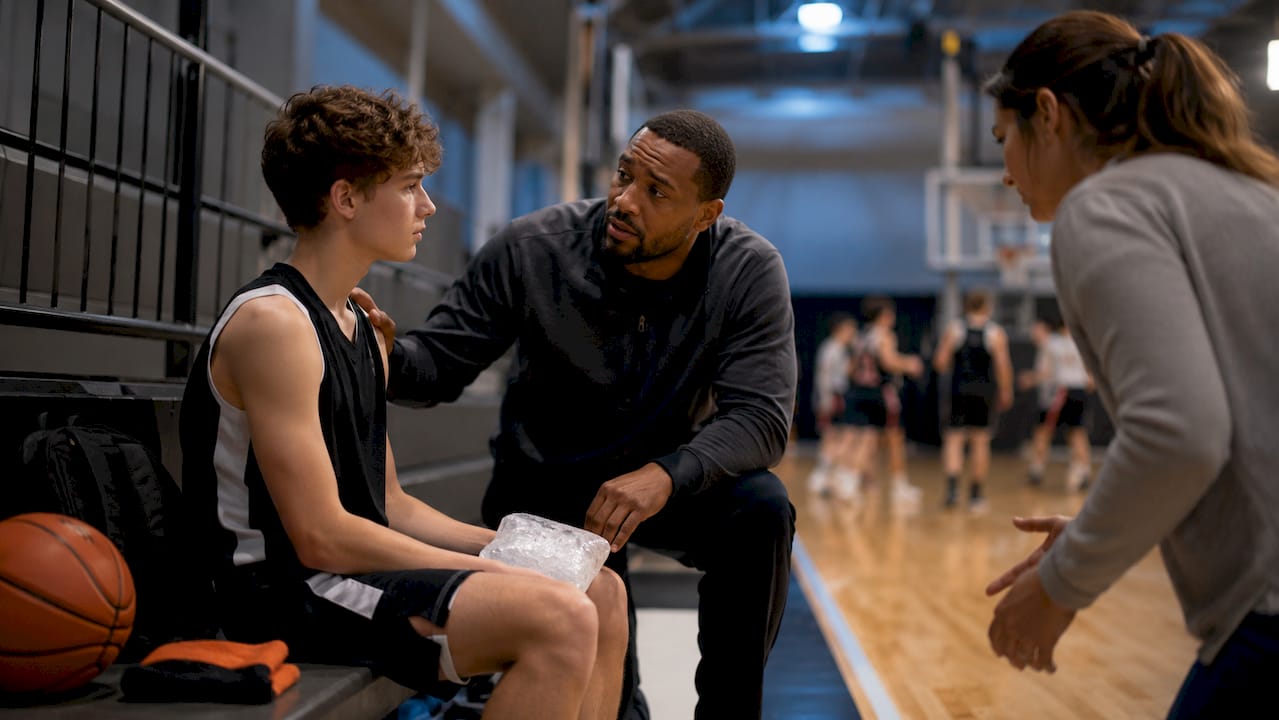
What made it work wasn't the hit, it was the boring part: someone wrote down the time, what happened, and what was said to the parent, right then, not the next day from memory. That kid sat out three full weeks and came back cleared, symptom-free, with paperwork nobody had to scramble to reconstruct later.
The lesson isn't complicated. Communicate early, document while it's fresh, and never let anyone talk you into skipping the clearance step because "he seems fine." Fine is not a medical opinion.
— Abdulazeez
Get Concussion Documentation Out of the Glove Compartment
Athlo gives coaches and parents a faster way to handle the paperwork side of youth sports safety without replacing anyone's medical judgment. Medical forms, waivers, and consent documents live in one shared space instead of scattered across texts and paper folders, and event attendance tracking through LinkUp means there's a timestamped record of who showed up, which matters when a notification form needs an exact time and place.

To be direct about what this is and isn't: Athlo does not diagnose concussions, clear athletes to return, or replace a licensed health care provider's evaluation. What it does is make it easier for a coach to upload a clinician's written clearance, message a parent about status updates, and keep that record accessible instead of buried in a bag. If you're coordinating a coach through the coaching marketplace, that same document trail follows the relationship instead of living in a single person's inbox. Coaches managing rosters across seasons already know how much admin this saves, the same way apps have started simplifying coach paperwork across other parts of the job.
Download Athlo on the App Store or Google Play and set up your team's medical forms before the next practice, not after the next incident.
Sources
- Returning to sports | HEADS UP | CDC
- Sport-related concussion: Evaluation and management - PMC
- MEDICAL CLEARANCE TO RETURN TO PLAY AFTER SUSPECTED CONCUSSION (Ohio form)
- Concussions in Youth Athletes - Little League
FAQ
What is the concussion protocol for youth sports?
Remove the athlete from play immediately, never allow same-day return, get evaluation and written clearance from a licensed health care provider, and follow a 6-step graduated return-to-play progression with at least 24 hours between each step.
How long should a kid stay out of sports after a concussion?
There's no fixed number of days; recovery is individualized and tied to being symptom-free at each step of the return-to-play progression, with children and teens often taking longer than adults to fully recover.
What is the 20-20-20 rule for concussions?
There's no widely recognized clinical "20-20-20" rule in concussion management guidance; the number that matters is the minimum 24 hours required between each of the six return-to-play steps.
What are the recommended concussion protocols for sports?
Immediate removal, no same-day return, licensed medical evaluation and clearance, a documented 6-step return-to-play progression, and return-to-learn accommodations at school before full physical clearance, following CDC HEADS UP and state law requirements.
Who can clear a youth athlete to return to play?
Only a licensed health care provider, and which provider types qualify (physician, nurse practitioner, physician assistant, or supervised athletic trainer) depends on your specific state's law, so check your state's youth concussion statute directly.