
An effective sports emergency action plan is a short, venue-specific script that names roles, gives the exact 911 call script, maps AEDs within a 3-minute retrieval window, and gets rehearsed with EMS before anyone needs it. If your program doesn't have that one-pager posted at every field, gym, and pool right now, your next move is simple: draft it, print it, post it, and run a Medical Time Out before your next event.
TL;DR:
- Venue-specific plans should clearly assign roles, have an exact 911 call script, and include mapped AED locations that can be reached within three minutes.
- Regular rehearsals, at least once or twice a year, and a pre-event Medical Time Out significantly improve response effectiveness during actual emergencies.
- Coordinating with local EMS by sharing venue maps, confirming ambulance routes, and establishing hospitals reduces response delays in critical moments.
- A laminated, one-page quick-reference sheet posted at each venue, combined with digital copies, ensures critical information is accessible during emergencies.
Table of Contents
- What Is an Emergency Action Plan in Sports?
- What Should Every Sports Injury Response Plan Include?
- How Do You Build a Venue-Specific EAP Template?
- What Are the Steps in a Sports Emergency Response?
- How Often Should You Rehearse and Review Your EAP?
- How Should You Coordinate an EAP With Local EMS?
- Your One-Page Quick-Reference EAP: What to Include and Where to Keep It
- Who Is Legally Responsible When an EAP Fails?
- What Are Common Sports Emergencies and How Do Plans Differ?
- What Training Do Coaches and Staff Need to Run an EAP?
- The Single Biggest Change Teams Can Make Right Now
- Where Athlo Fits Into Your EAP Workflow
- Templates and Guidance Worth Downloading
- Sources
- FAQ
What Is an Emergency Action Plan in Sports?
An emergency action plan (EAP) is not your district's 40-page risk management policy. It's a one-page, venue-specific script that tells the people standing on the field exactly what to do in the first five minutes after something goes wrong. Confusing the two is where most athletic programs get into trouble.
The National Athletic Trainers' Association position statement defines an EAP as a written document specific to the venue where an emergency occurs, built for catastrophic injuries like cardiac arrest, heat stroke, or spinal trauma. NATA recommends every organization name an EAP coordinator, distribute the plan to all stakeholders, review it annually, and rehearse it, not just file it in a binder. A policy manual explains your insurance requirements and staffing philosophy. An EAP tells the assistant coach which gate to unlock when the ambulance arrives. Those are different jobs, and mashing them into one document is why so many "emergency plans" never get used when it counts.
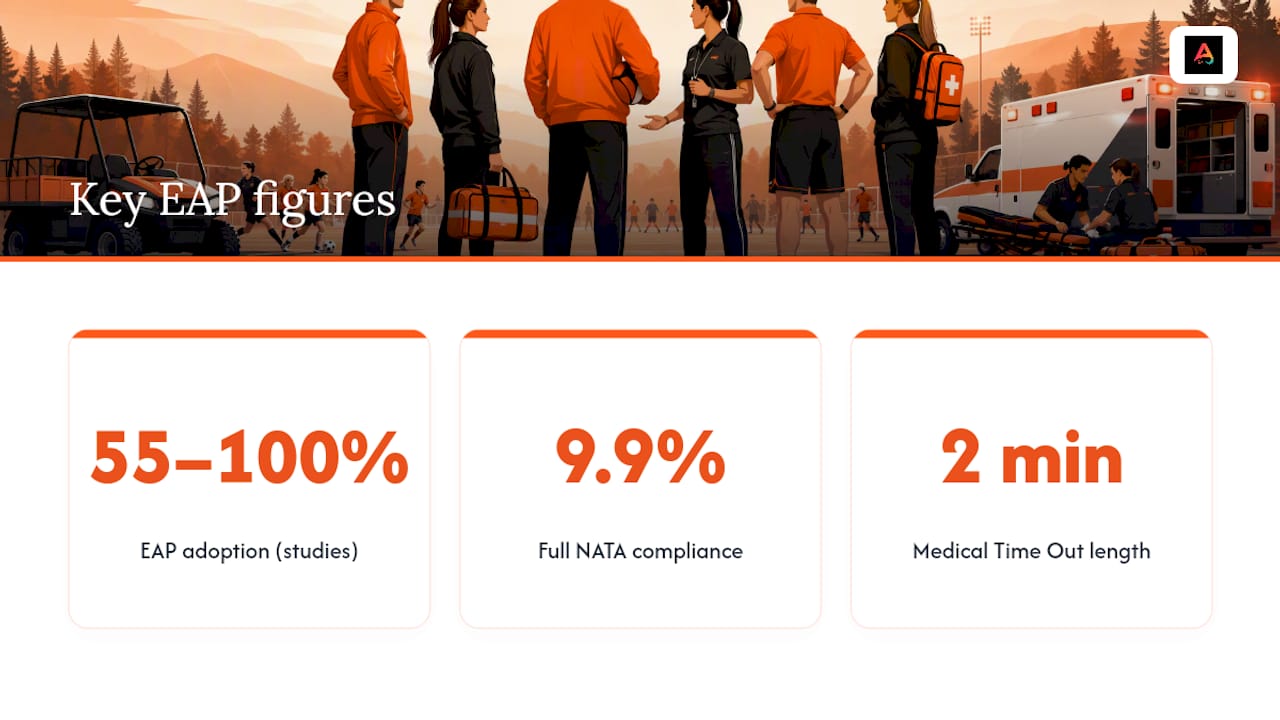
The Korey Stringer Institute pushes this even further by recommending a pre-event Medical Time Out, a two-minute huddle where staff confirm who's calling 911, who's meeting EMS, and where the AED lives, before the whistle even blows. That single habit closes the gap between a plan that exists and a plan that works.
Venue specificity matters more than most administrators assume. A plan written for your main gymnasium is close to useless at the auxiliary soccer field a half-mile away with a different gate, a different address, and an AED that's a two-minute walk in one location and a five-minute walk in the other. A systematic review of school-based athletics found EAP adoption rates ranging from 55% to 100% depending on the study, but full compliance with NATA's recommended guidelines sat at roughly 9.9%. The same review found schools with AEDs on-site had noticeably higher EAP adoption overall, which tells you equipment and planning tend to move together, not separately.
Think about the difference between a gym and an outdoor soccer complex. Indoors, your biggest risks are cardiac events and head injuries in a controlled, enclosed space with one or two entry points. Outdoors, you're dealing with lightning, heat illness, multiple gates, parking lot access for EMS, and an AED that might be sitting in the wrong building entirely. A single generic template can't cover both. That's the entire argument for going venue by venue instead of writing one plan and hoping it stretches.
Pro Tip: If you manage multiple facilities, color-code your EAPs by venue and store a physical copy in the first aid kit at each site. A digital version helps for review and distribution, but a laminated card at the site is what someone actually grabs during a crisis.
What Should Every Sports Injury Response Plan Include?
Every venue-specific EAP needs the same backbone, even if the details change site to site. Skip one of these pieces and you've built a document that looks thorough but leaves a gap exactly when someone needs it filled.
Roles and chain of command. Name specific people, not job titles, wherever possible. Who calls 911? Who starts first aid or CPR? Who meets EMS at the gate and walks them in? Who keeps the rest of the team and any spectators back? KSI's guidance is blunt on this point: ambiguity about who does what is one of the most common causes of delayed emergency response, and assigning roles out loud during a Medical Time Out fixes it before it becomes a problem.
The 911 call script. Don't leave this to improvisation under stress. Write out exactly what the caller says: the venue's full street address, the nearest cross street or gate number, the nature of the emergency, and the patient's condition. The caller stays on the line until EMS arrives on scene, full stop. This single instruction, stressed repeatedly by KSI, prevents the common mistake of hanging up too soon and forcing dispatch to call back for details nobody thought to give the first time.
Emergency equipment readiness. An AED needs to reach a collapsed athlete within three minutes of the emergency starting, according to NATA's position statement. That's not a suggestion, it's the standard cardiac arrest survival research is built around. Meeting it requires daily readiness checks, confirming the battery is charged, the pads haven't expired, and the unit is actually where the map says it is.
By the Numbers: Compliance with recommended EAP practices in U.S. school athletics sits at roughly 9.9% despite adoption rates as high as 100%, meaning most programs have some plan but very few meet the full standard for rehearsal, distribution, and documentation.
Posting, distribution, and documentation. The plan needs a name attached to it, someone who signed off on the current version, and a posted location at the venue itself, not just a shared drive nobody opens under pressure. Here's the core checklist to run through for any venue:
- Assign and name the 911 caller, first responder, and EMS gate contact by role and by person
- Write the exact 911 script including address, gate number, and patient condition
- Confirm AED location and test that it's reachable within 3 minutes on foot
- Run a daily or pre-event equipment check on AED battery, pads, and first aid kit stock
- Get a signature from the athletic director or EAP coordinator on the current version
- Post a physical copy at the venue and attach one to the primary medical kit
That last point deserves emphasis: a digital copy stored in an app or a shared folder is genuinely useful for review, distribution, and keeping everyone on the same version, but it does not replace a clearly posted, laminated one-pager at the site itself. When someone's heart stops, nobody is opening a PDF.
How Do You Build a Venue-Specific EAP Template?
Building the actual document is more straightforward than most administrators expect, largely because you're not writing prose. You're filling in a structured, fillable form. KSI's EAP template, developed alongside West Virginia University, gives you that exact structure and is worth adapting rather than building from scratch.
Start with a venue header that leaves zero room for confusion during a 911 call. That means the exact street address (not the school's mailing address if the field sits elsewhere), GPS coordinates if the site is hard to find by address alone, the primary gate EMS should use, any gate code needed to get in, and notes on where ambulances should park. A youth complex with six fields and one main entrance needs this spelled out more, not less, because "meet at the field" means nothing to a driver who's never been there.
Next, map every AED on-site and time the walk from each point of play to the nearest unit. This is where the 3-minute standard gets tested for real instead of assumed. Walk it yourself, stopwatch in hand, from the farthest corner of the field or court to the AED cabinet. If it takes four minutes, you don't have a paperwork problem, you have an equipment placement problem, and the fix is moving the AED, not editing the plan to pretend the walk is faster than it is.
Your appendix should carry three things every coach and staff member can find without searching: the nearest hospital's name and address (ideally one with pediatric or trauma capability if that matters for your sport), the likely ambulance route from the venue, and the phone number of whoever holds the keys to any locked gates EMS might encounter after hours.
| Template Section | What Goes In It | Who Fills It Out |
|---|---|---|
| Venue header | Address, GPS, gate number, gate code, parking notes | Facility manager or AD |
| Roles and chain of command | Named 911 caller, first responder, EMS gate contact | EAP coordinator |
| 911 call script | Exact wording, address, patient condition prompts | EAP coordinator, reviewed with staff |
| Equipment map | AED location, walk time, first aid kit location | Athletic trainer or safety officer |
| Hospital and EMS appendix | Nearest hospital, ambulance route, gate key holder | EAP coordinator, coordinated with EMS |
Format the finished document to fit on one page, front and back at most. Print it, laminate it, and post it inside the equipment shed, the scorer's table, or wherever staff naturally congregate at that specific site. Keep a second laminated copy clipped inside the primary medical kit, since that's the item most likely to be grabbed first. Store a digital version too, ideally somewhere every coach can pull it up on a phone, but treat that as backup, not the primary copy.
If you're managing logistics across an entire tournament weekend rather than a single practice field, the planning overlaps heavily with general event logistics, gate control, and parking coordination covered in a tournament director's playbook, worth a look if you're building both documents at once.
What Are the Steps in a Sports Emergency Response?
When something goes wrong, hesitation costs time nobody has to spare. A written activation script, memorized and rehearsed in advance, replaces panic with a sequence.
- Check the scene and the athlete. Confirm the area is safe to approach, then check circulation, airway, and breathing (CAB). This takes seconds, but skipping it means missing something like an unsafe field condition or a second injured athlete.
- Assign roles out loud. If your Medical Time Out already named a 911 caller, first responder, and EMS gate contact, this step is just confirming those people are present and activating. If it wasn't done in advance, someone in charge needs to point at specific people right now, not ask for volunteers.
- Call 911 and stay on the line. The caller states the exact address, the nearest gate or cross street, the nature of the emergency, and the athlete's condition, then keeps the phone connected until EMS physically arrives. A sample script: "I need an ambulance at 400 Field House Drive, enter through Gate 3 off Maple Street. A 15-year-old male athlete is unresponsive, not breathing normally, we are starting CPR now."
- Retrieve the AED and begin CPR. Whoever is trained starts chest compressions immediately, following American Heart Association guidance, while a second person retrieves the AED and applies it as soon as it's ready. Compressions should not stop for more than a few seconds at a time.
- Send someone to flag EMS at the gate. This person's only job is standing at the designated entrance, waving down the ambulance, and walking it directly to the athlete. Every second EMS spends searching for the right field is a second the athlete doesn't get.
- Keep the scene clear. A separate staff member manages teammates, other players, and any spectators, keeping the area open for responders and shielding the athlete's privacy.
- Document as it happens. One person, ideally not directly involved in care, notes the time of collapse, time of 911 call, time of AED application, and any changes in condition. This record matters for EMS handoff and for any review afterward.
Pro Tip: Print the exact 911 script with blank lines for the address and gate number, and staple it to the inside of every first aid kit. Under stress, people forget details they'd never forget on a calm afternoon. Reading from a script beats reciting from memory every time.
How Often Should You Rehearse and Review Your EAP?
A plan that lives in a binder is not a plan, it's a liability with good intentions. NATA recommends reviewing and rehearsing your EAP at minimum once per year, and documenting that the rehearsal actually happened, who participated, and what was learned.
Rehearsal starts small. A daily readiness check on AED battery status, pad expiration, and first aid kit stock takes under two minutes and should happen before every practice or event where a trainer or coach is on-site. Before competitions specifically, run the Medical Time Out KSI recommends: gather coaching and medical staff, confirm the 911 caller, confirm the EMS gate contact, and point out the AED location out loud, even if everyone thinks they already know.
Roughly 9.9% of school athletic programs meet full NATA compliance on EAP recommendations, even though most claim to have a plan on file. The gap between "having a plan" and "rehearsing a plan" is where that number lives.
Bigger rehearsals, ideally once or twice a year, should involve actually walking through a scenario with a stopwatch: someone plays the collapsed athlete, the team runs the full sequence, from scene check to AED application to EMS arrival at the gate, and you time each phase. Inviting your local EMS unit to participate in at least one of these drills pays off directly, since they'll get to know your venue's quirks before they're navigating it during a real call.
A short list of scenarios worth practicing on rotation:
- Sudden cardiac arrest during practice with no athletic trainer present
- Suspected spinal injury after a collision, requiring stabilization before movement
- Heat illness during a summer outdoor practice with delayed recognition
- A visiting team's athlete going down with your staff unfamiliar with their medical history
After any real event or drill, run a short debrief. What took longer than expected? Did the AED map hold up? Did the 911 caller have the right address memorized or did they have to look it up? Feed every answer back into the written plan so next year's version is sharper than this year's.
How Should You Coordinate an EAP With Local EMS?
Your EAP is only as good as the people responding to it, which means local EMS should see it before an emergency, not during one. Invite your area's EMS unit for a facility walkthrough at least once, hand them a copy of the venue map showing gates, AED locations, and parking, and ask directly whether your assumed ambulance route actually works for their vehicles.
Agree on staging and routing in advance rather than guessing. Some venues have a preferred ambulance entrance that isn't obvious from the street, or a gate that requires a code EMS won't know unless you've told them. Settling this ahead of time, and writing it into the appendix, removes a source of delay that has nothing to do with medical care and everything to do with logistics nobody thought to coordinate.
Identify your realistic receiving hospital, meaning the one EMS will actually transport to given your location, not just the closest one on a map. For programs with athletes who have known conditions, ask families whether a specific hospital matters for continuity of care, and note that in the plan. Establish who calls ahead to notify the receiving hospital, since a heads-up before the ambulance arrives can shave critical minutes off treatment on arrival.
For larger events, tournaments, or anything with elevated risk, meaning contact sports, extreme heat conditions, or high spectator counts, consider contracting an on-site ambulance or advanced life support (ALS) unit rather than relying solely on a 911 response. A few practical coordination points worth locking down before the season starts:
- Schedule at least one EMS walkthrough of your primary venues before the season begins
- Share your venue map, gate codes, and AED locations directly with the responding agency
- Confirm your default receiving hospital and who calls ahead to notify them
- Decide in advance whether large events warrant a contracted on-site ambulance
Your One-Page Quick-Reference EAP: What to Include and Where to Keep It
Every venue needs a single laminated sheet that answers four questions instantly: who calls 911 and what do they say, where's the AED, who meets EMS, and who do we call if something's unclear. That's the entire job of a quick-reference EAP, and it works precisely because it refuses to be anything more complicated than that.
Build it with these sections, in this order:
- The exact 911 script with blanks filled in for your specific address and gate number
- A simple map showing AED location relative to the field or court, with the timed walk noted
- Named EMS gate contact and their role, not just a title
- A short contact list: EAP coordinator, facility manager, gate key holder, nearest hospital
Physical distribution matters as much as content. Laminate it, post one copy at the venue itself, and clip a second inside the primary medical kit. For digital backup, store a copy somewhere every coach can pull up on a phone during travel to away games or scrimmages at unfamiliar sites, since the away team rarely has the home venue's plan memorized.
This is also where a tool built for youth and school sports logistics earns its place. Athlo gives coaches and organizers a spot to manage medical forms and waivers alongside event details, so the people who need a venue's emergency information have somewhere central to find it instead of digging through email threads before a tournament. Pair distribution through an app like Athlo with the physical laminated copy at the site, never as a replacement for it, and you've closed the gap between having a plan and actually being able to reach it.
Who Is Legally Responsible When an EAP Fails?
Liability in youth and school sports generally follows a standard of reasonable care, meaning courts and insurers ask whether your organization did what a reasonably prudent athletic program would do to prepare for foreseeable emergencies. A written, rehearsed, venue-specific EAP is strong evidence you met that standard. The absence of one, or a stale plan nobody's looked at in three years, tends to work against you if an incident leads to a claim.
Documentation carries real legal weight here. Signed sign-off from an athletic director or EAP coordinator, dated rehearsal records, and daily equipment readiness logs all demonstrate active management rather than a plan that exists purely on paper. The AHA's Cardiac Emergency Response Plan guidance specifically recommends posting the plan publicly and providing copies to local EMS, both of which create a paper trail showing your organization took preparation seriously rather than treating it as a formality.
Many states have Good Samaritan and AED-specific liability protections for trained responders acting in good faith during an emergency, though the exact scope varies by state and by whether the responder is a paid staff member or a volunteer. Check your specific state's statute rather than assuming blanket protection, since coverage details differ enough that a generic answer could leave a volunteer coach exposed in ways they didn't expect. Consulting your school district's legal counsel or your organization's insurance carrier before finalizing an EAP is worth the hour it takes, particularly around who's authorized to use an AED and what training documentation your insurer expects on file.
What Are Common Sports Emergencies and How Do Plans Differ?
Not every emergency looks the same, and a plan that only covers sudden cardiac arrest leaves gaps for the scenarios that actually happen more often on a given weekend.
Sudden cardiac arrest demands the fastest possible AED access and immediate CPR, which is why the 3-minute retrieval standard anchors so much of EAP design. Heat illness, especially during summer conditioning or two-a-days, requires a different response: recognizing early symptoms, cooling the athlete immediately (ice baths or cold water immersion where available), and treating it as a time-sensitive emergency even when the athlete is still conscious and talking.
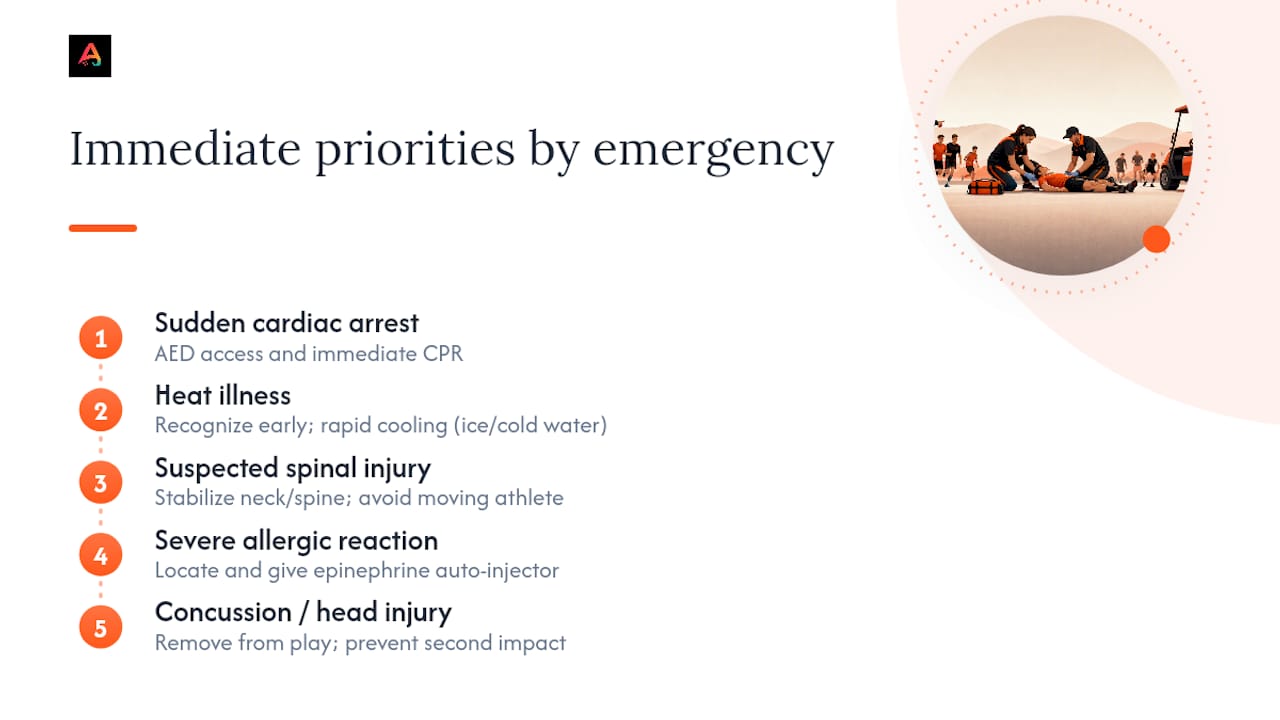
Suspected spinal injury after a collision or fall changes the entire approach. Movement before stabilization can cause permanent damage, so the plan needs to specify who's trained to stabilize the neck and spine and that the athlete isn't moved until qualified help arrives, even if that means waiting through an uncomfortable few minutes.
Severe allergic reactions, particularly relevant for outdoor sports near bee activity or events with concession food, require staff to know whether any athlete carries an epinephrine auto-injector and where it's stored during practice or competition. Concussions and head injuries need a clear removal-from-play protocol, since the biggest risk isn't the initial hit but a second impact before the first has resolved.
Each of these deserves its own short line item in your venue EAP, specifying the recognition signs and immediate first step, so staff aren't trying to improvise a category of response they've never walked through before.
What Training Do Coaches and Staff Need to Run an EAP?
An EAP is only as reliable as the people executing it, which means training can't be a one-time orientation slide deck. Current CPR and AED certification, renewed on the cycle your certifying body requires (commonly every two years per AHA guidance), should be a baseline requirement for at least one staff member present at every practice and event, not just the head coach.
Beyond certification, every staff member and regular volunteer needs a walkthrough of the specific venue's EAP, not a generic overview of emergency response in general. That means knowing where the AED sits at that field, who's assigned to call 911 at that site, and what the exact gate number is for EMS entry. A volunteer parent helping run the concession stand at a tournament doesn't need CPR certification, but they do need to know who to alert if something happens near them.
New staff and volunteers should get this walkthrough before their first event, not sometime during the season once someone remembers to mention it. Build it into onboarding the same way you'd cover a code of conduct or a schedule, since skipping it is exactly how gaps in coverage happen. Refresh the entire staff annually alongside your required plan review, ideally timed to preseason so the information is fresh when the risk of injury actually climbs.
The Single Biggest Change Teams Can Make Right Now
Most athletic programs already have some version of an emergency plan sitting in a filing cabinet or a shared drive. Almost none of them have rehearsed it in the last twelve months. That gap, not a missing document, is the real problem.
Paperwork feels like progress because it's easy to produce and easy to point to during an audit. Rehearsal is uncomfortable, takes actual time out of a practice schedule, and doesn't produce a document you can hand someone. But rehearsal is the only thing that reveals whether your AED walk actually takes three minutes or five, whether your assigned 911 caller actually knows the venue's exact address, and whether your EMS gate contact even knows which gate that is. A plan nobody's walked through is a guess dressed up as preparation.
Here's the 30-day version, no committee required. Week one, print and post a one-page EAP at every venue you're responsible for. Week two, schedule one drill, even a stripped-down 20-minute version during a practice, timing the AED retrieval and the 911 script out loud. Week three, invite your local EMS unit for a walkthrough, even a brief one. Week four, debrief what broke, and fix the plan before next season, not after an incident forces the issue.
— Abdulazeez
Where Athlo Fits Into Your EAP Workflow
None of this replaces a posted, laminated one-pager at your venue, but keeping medical forms, waivers, and event details organized digitally solves a real problem: coaches and parents constantly asking where the latest version of something lives.

Athlo gives coaches and organizers a central place to manage medical forms and waivers for their rosters, alongside event details for practices, games, and tournaments booked through the app. If you're already using Athlo to run pickup games through LinkUp or manage a coaching roster, that same hub becomes a natural place to keep parents' emergency contact information current and confirm which families have submitted required medical paperwork before the season starts. It won't post your AED map at the gym, but it solves the "who has the current version" problem that quietly undermines a lot of well-intentioned plans.
If you're managing event logistics on top of safety planning, QR-ticketed events through Athlo also give you a built-in check-in record, useful if you ever need to confirm exactly who was on-site during an incident. Download Athlo on the App Store or Google Play to get your rosters, forms, and event info into one place before your next practice or tournament weekend.
Templates and Guidance Worth Downloading
Build your plan on frameworks that have already been tested by organizations built specifically for sports safety, rather than starting from a blank page.
- NATA's position statement covers the full recommended structure, rehearsal cadence, and documentation standards for EAP development.
- KSI's EAP guidance explains the Medical Time Out and communication protocols in practical, applicable terms.
- KSI's fillable EAP template is the actual document to adapt for your venue, section by section.
- AHA's Cardiac Emergency Response Plan fills in the AED program and CERT coordination details the other two touch on more lightly.
This article is general information, not a substitute for advice from a qualified doctor. Consult a qualified healthcare professional about your own circumstances before acting on anything here.
Sources
- National Athletic Trainers' Association position statement: Emergency action plan development and implementation in sport
- Korey Stringer Institute — EAP guidance
- KSI EAP template (Revised 2024)
- AHA Cardiac Emergency Response Plan (CERP) — Sports facilities
FAQ
What Is an EAP in Sports?
An EAP, or emergency action plan, is a written, venue-specific document that names who responds to a medical emergency, how they call for help, and where emergency equipment is located, according to NATA's position statement.
Can You Give an Example of a Sports Event EAP?
A youth soccer complex's EAP would list the exact field address and gate number, name the assigned 911 caller and EMS gate contact, map the AED location with its timed walk distance, and include the nearest hospital and ambulance route in an appendix, following the structure in KSI's fillable template.
What Are the Steps in an Emergency Action Plan?
A typical activation sequence runs: check the scene and the athlete, assign or confirm roles, call 911 and stay on the line, retrieve the AED and begin CPR, send someone to flag EMS at the gate, keep the area clear, and document the timeline as it happens.
What Makes a Good Emergency Action Plan for a Sports Team?
A good EAP is short enough to fit on one page, specific to the exact venue it covers, rehearsed at least annually per NATA guidance, and posted physically at the site rather than buried in a digital folder nobody opens during a crisis.
How Often Should an EAP Be Reviewed or Rehearsed?
NATA recommends reviewing and rehearsing an EAP at minimum once a year, alongside daily equipment readiness checks and a Medical Time Out before each competition, per KSI's guidance.