
Collect the payment once, tag it to one booking ID, and hold the money until it settles before you send a dime to anyone. That is the whole game. Split payouts to coaches work when you calculate every coach's share up front, onboard each coach with tax paperwork before you promise them a cut, and only release transfers once the platform confirms funds are available. Skip any of those steps and you are the one fielding angry texts when a chargeback eats a coach's payout two weeks later.
TL;DR:
- Collect full payments upfront, tag them with a single booking ID, and only transfer funds after they settle to avoid chargebacks.
- Confirm and onboard each coach with W-9 and bank details before opening registration or live event sales.
- Use separate charges and transfers to hold funds centrally, ensuring accurate reconciliation and liability management with Stripe.
- Require coaches to complete identity verification and tax forms prior to payout to ensure compliance and avoid frozen funds.
- Disclose total fees upfront and detail refund and cancellation policies clearly in the payout agreement to prevent disputes.
Table of Contents
- How Do You Split Payouts to Coaches Step by Step?
- What Are the Technical Options for Splitting One Payment?
- What Onboarding and Tax Rules Apply to Coach Payouts?
- What Should a Coach Payout Agreement Include?
- How Do You Reconcile and Record Coach Payouts?
- Why Athlo Builds Payout Splitting Into the Marketplace
- Get Paid Without the Payout Guesswork
- Sources
- FAQ
How Do You Split Payouts to Coaches Step by Step?
Most payout disasters happen because organizers pay first and figure out the math later. Flip that order.
- Confirm recipients before you open registration. List every coach getting a cut, collect a completed W-9 from each one, and grab their bank or payout account details.
- Lock in the split. Decide fixed dollar amounts or percentages, and write down whether the split applies to the gross ticket price or the amount left after processing fees.
- Set up checkout with one charge. Price the event, then calculate what processing and platform fees pull out of that distributable pool before anyone gets paid, using detailed Golf Tournament Software Pricing models to compare how fees affect the distributable pool when planning ticket pricing.
- Capture the payment as a single transaction. Tag it with a booking or transfer_group ID that never changes, no matter how many coaches are attached to it.
- Hold the funds. Don't transfer a dollar until the payment settles. This is your buffer against refunds and chargebacks.
- Issue transfers tied to that same booking ID, and log every transfer ID the moment it happens.
- Reconcile after the event. Run a ledger check, then send each coach a statement showing exactly how their number was calculated.
Pro Tip: Build your split sheet before you build your registration page. If you're still negotiating percentages after people have already paid, you've already lost control of the timeline.
This sequence mirrors the operational workflow ticketing attorneys recommend for events collecting one payment on behalf of multiple parties: identify recipients, calculate shares, collect, wait, then transfer.
What Are the Technical Options for Splitting One Payment?
There are two standard charge models behind almost every marketplace payout, and picking the wrong one is how organizers end up personally liable for a coach's negative balance.
- Separate charges and transfers. The platform collects the full charge, then sends individual transfers to each connected account after the fact. This is the right model whenever you're splitting one payment among multiple coaches, since it lets the platform hold funds and absorb liability instead of pushing that risk onto a single coach's account.
- Destination charges. These route the full charge (minus a set fee) to one connected account automatically. That works fine for a single coach getting paid directly, but it does not naturally support dividing one payment across several people, so most multi-coach bookings should avoid it.
- transfer_group and source_transaction. Stripe's documentation on separate charges and transfers recommends tagging every transfer tied to one purchase with the same transfer_group value, so reconciliation stays clean even months later.
- Settlement timing. Platforms can configure automatic or manual payout schedules, including a delay_days setting that holds funds longer to cover dispute risk.
- Same-region requirement. Transfers generally need to move between accounts in the same country or region, and someone on your team needs to watch the platform balance so a payout doesn't fail from insufficient funds.
What Onboarding and Tax Rules Apply to Coach Payouts?
You cannot pay a coach you haven't verified, and you cannot pretend fees are invisible to buyers. Both rules have teeth in 2026.
- Identity verification comes first. Stripe Connect requires identity and banking verification before payouts activate. Collect this during onboarding, not the week of the event, or a transfer will sit frozen while a coach scrambles for documents.
- W-9s are non-negotiable. Every contractor coach fills one out before their first payout. It's also how you avoid nominee-recipient headaches when one payment legally belongs to several people.
- 1099-K thresholds matter, but they're not the whole story. For 2026, the IRS threshold for Form 1099-K generally kicks in once a coach's payments exceed $20,000 and 200 transactions. Below that, a coach still owes tax on every dollar earned, form or no form.
- Fee disclosure isn't optional for ticketed events. The FTC's rule on live-event ticketing requires showing the total price, including mandatory fees, up front, along with a truthful description of what each fee covers and whether it's refundable.
A number worth remembering: that $20,000 and 200 transaction threshold is a reporting trigger for the platform, not a tax exemption for the coach. Plenty of organizers assume no 1099-K means no tax obligation. It doesn't work that way.
What Should a Coach Payout Agreement Include?
A verbal handshake on percentages falls apart the second a parent disputes a charge. Put it in writing before the first ticket sells.
- Event or session ID that matches the booking ID used in your payment system, so the agreement and the transaction never drift apart.
- The exact split, stated as a fixed amount or percentage, plus whether it applies before or after processing and platform fees.
- Payout eligibility date and the reserve or hold period you're using to cover chargebacks, along with who eats a negative balance if a refund happens after payout.
- Cancellation and refund terms, spelled out clearly enough that a parent asking for a refund in week three knows exactly what happens to the coach's cut.
- Onboarding conditions, meaning the coach confirms a completed W-9 and verified bank details before the agreement takes effect.
- Statement delivery terms, meaning how and when each coach receives a breakdown of their payout.
Pro Tip: Attach the payout math as an addendum, not a paragraph buried in the contract body. Coaches read numbers faster than they read legal language, and a clear table heads off half the "where's my money" messages before they're sent.
Athlo's guide on building coach contracts walks through this same language in template form, and the cancellation policy template covers the refund clause specifically.
How Do You Reconcile and Record Coach Payouts?
Reconciliation is just matching what went out against what should have gone out, using one ID as the thread that ties it all together.
- Anchor everything to the same booking or transfer_group ID across the charge, every transfer, every refund, and every reversal.
- Capture the full ledger, including customer amount, discounts, taxes, mandatory fees, processor fee, marketplace fee, refundable amount, chargeback adjustments, each coach's allocation, transfer status, and final net.
- Match charge to transfers to payouts, flag any reversal, and adjust the ledger before you close the books on that event.
- Send coach-facing statements that mirror what you'd need to hand the IRS if anyone ever asked.
Athlo's cashless payments checklist breaks this reconciliation routine down for organizers running multiple events a season.
Why Athlo Builds Payout Splitting Into the Marketplace
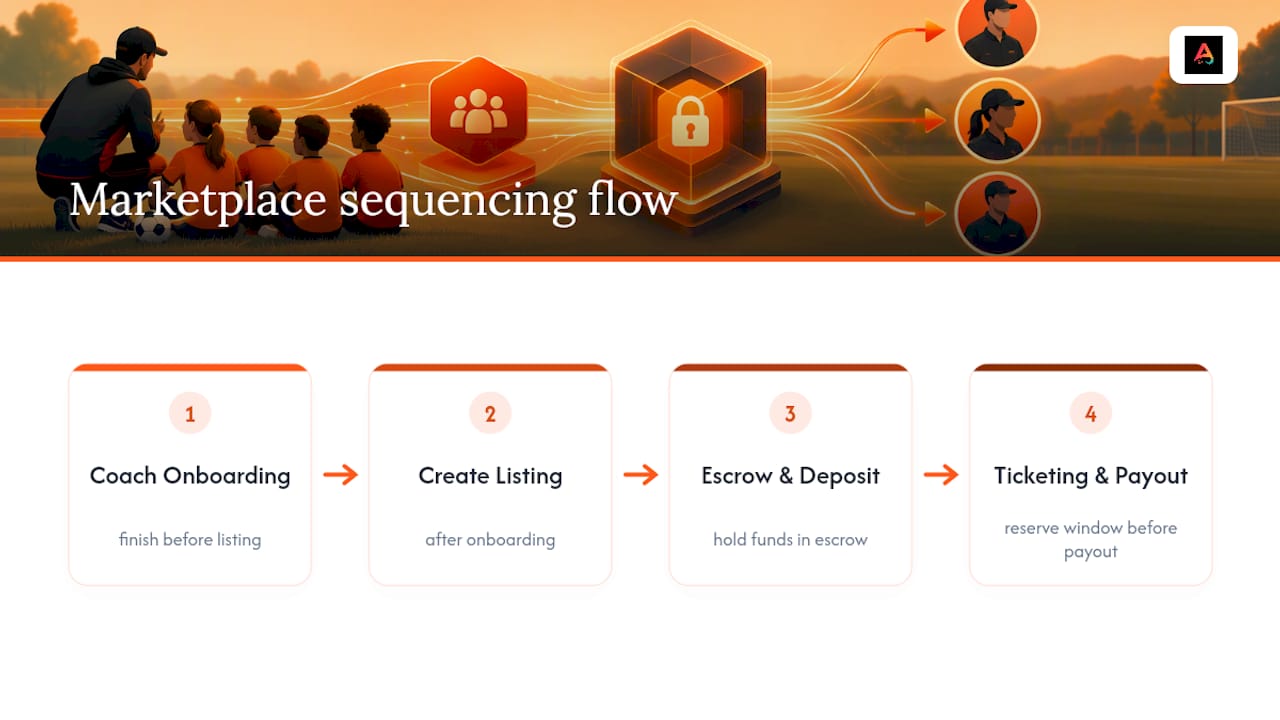
Most of the payout problems organizers run into aren't math problems. They're sequencing problems. Someone lists a coaching session before that coach has finished onboarding, or a ticketed event goes live before anyone has agreed on the split, and now you're improvising with real money on the line.
Athlo consolidates booking, escrow, payments, and QR ticketing into one flow specifically so the sequencing happens in the right order. Our coaching escrow playbook walks through deposit structures and payout timing in more detail. My advice after digging through this workflow: require full coach onboarding before a listing goes live, and build a reserve window into every event, not just the big ones. The small pickup game is exactly where organizers skip this step, and exactly where it bites them.
— Abdulazeez
Get Paid Without the Payout Guesswork
Athlo gives youth and high-school sports organizers one place to list a coaching session, sell tickets with QR entry, and route secure escrow payments to every coach attached to that booking, instead of juggling a payment app for collection and a group text for math. The coaching marketplace handles onboarding, the event ticketing feature handles entry and total-price disclosure, and escrow payments hold funds the way this whole article just walked through.

If you're planning a clinic, tournament, or multi-coach training session, start by setting up your listing on the coaching marketplace and confirming onboarding for every coach before you open registration. Download Athlo on the App Store or Google Play to get started, or check plan details, including Athlo Plus at $3.99 per month and Athlo Pro at $7.99 per month, at Athloapp.
Sources
- Accept a payment | Stripe Connect
- Create separate charges and transfers | Stripe
- Manage payout schedule | Stripe
- Understanding your Form 1099-K | IRS
- Rule on unfair or deceptive fees — FAQs | FTC
FAQ
What Is the Best Way to Split One Payment Among Coaches?
Collect the full payment once through your platform, tag it with a single booking ID, and issue separate transfers to each coach after the funds settle. This keeps the split auditable and avoids pushing chargeback risk onto any one coach's account.
Do Coaches Need to Fill Out Tax Forms Before Getting Paid?
Yes. Collect a completed W-9 from every coach before their first payout, since this avoids nominee-recipient confusion and supports accurate IRS reporting. Coaches owe tax on their earnings regardless of whether a 1099 form is issued.
When Does a Coach Get a 1099-K for Payout Income?
For 2026, platforms generally issue a Form 1099-K once a coach's payments cross $20,000 and 200 transactions in a year. Income below that threshold is still taxable, it just may not come with a form.
Do I Have to Show Ticket Fees Separately or Combined?
The FTC's live-event ticketing rule requires showing the total price including most mandatory fees, along with an honest description of what each fee covers. Hiding fees until checkout is the exact practice this rule targets.
Can Athlo Handle Payout Splitting for a Multi-Coach Event?
Athlo's coaching marketplace and event ticketing tools handle booking, QR entry, and secure escrow payments in one place, which supports the onboarding-then-payout sequence this article describes. Check the coaching page or download Athlo on the App Store or Google Play for current features.