
Hire a safe, development-focused youth coach with five moves: define the role in writing, require a background check plus SafeSport and first-aid training, run a structured interview with scenario questions, call at least two references, then onboard with a written code of conduct. Skip any of those five and you're gambling with a kid's season.
TL;DR:
- A thorough background check, SafeSport certification, and current CPR and first-aid training should be verified personally and renewed every two years, with documentation kept securely.
- Behavioral and scenario-based interview questions, along with reference checks focusing on reliability and conflict management, provide a clearer picture of a coach’s true suitability.
- Onboarding must include a written emergency plan, practice templates, a conduct code, parent communication scripts, and a probation period with scheduled progress reviews.
- Coaches should hold sport-specific, age-appropriate training and certifications, with emphasis on abuse prevention, safety recognition, and proper coaching methods.
- Using a centralized digital platform streamlines hiring, paperwork, and communication, reducing errors and ensuring compliance throughout the coaching season.
Table of Contents
- How to Hire a Youth Coach: The Screening Checklist That Matters
- What Background Checks Should You Run, and How Often?
- What Questions Should You Ask a Youth Sports Coach?
- How Do You Onboard a New Youth Coach?
- Which Safety Certifications Should You Require?
- Red Flags That Should Stop a Hire
- What Does a Youth Coach's Job Actually Involve?
- How Long Does It Take to Hire a Youth Coach?
- How Much Does It Cost to Hire a Youth Coach?
- Athlo's Take: Paperwork Kills More Seasons Than Bad Coaching Does
- Find and Book Vetted Coaches Without the Spreadsheet Chaos
- Where to Go for Training and Screening Guidance
- Sources
- FAQ
How to Hire a Youth Coach: The Screening Checklist That Matters
Most volunteer leagues and travel clubs still hire on gut feeling. A parent recommends someone, that person played varsity ball twenty years ago, and boom, they've got a whistle and a roster. That approach works fine until it doesn't, and when it fails, it fails in front of a dozen nine-year-olds and their watching parents.
Playing experience and coaching ability are not the same skill. Someone who started at point guard in college may have zero ability to explain a pick-and-roll to an eight-year-old who just learned to dribble with both hands. Research on coaching competency backs this up directly: athletic résumé does not predict whether someone can adapt instruction to a kid's actual developmental stage. That's the first filter, before you even get to safety paperwork.
Here's the must-have list for any candidate, paid or volunteer:
- A clean background check, run through your league or a third-party screening service, not a self-reported "I'm clean" claim.
- SafeSport or an equivalent abuse-prevention certificate, dated within the last year.
- Current CPR and first-aid certification, with a card or digital badge you can verify.
- Sport-specific or age-group training relevant to the roster they'll coach (U8 soccer is not U14 soccer).
Verify every certificate yourself. Ask for a screenshot or a certificate number, then check it against the issuing organization's lookup tool rather than trusting a printed PDF. For volunteer coaches, you can flex slightly on formal coaching credentials if a co-coach with those credentials is on the bench. For paid roles, none of that flexibility applies. You're paying for expertise, so require proof of it upfront.
Pro Tip: Build a one-page candidate scorecard before you post the job. Score safety items as pass/fail and everything else on a 1 to 5 scale. It keeps volunteer parent committees from hiring the loudest personality in the room.
What Background Checks Should You Run, and How Often?
A background check is not a single box you check once and forget. It's a recurring safety practice, and skipping the renewal is one of the most common mistakes leagues make.
Here's the sequence recommended by youth sports governing bodies:
- Multi-jurisdiction criminal search. A single-county check misses records from other states. Run a national or multi-jurisdiction search every time.
- Sex-offender registry check. Non-negotiable, every candidate, every time, no exceptions for "I know his family."
- County criminal record search. This catches local records that sometimes lag behind national databases.
- Motor-vehicle record check. Required if the coach will ever drive kids to games or practices, even occasionally.
- Renewal. NCYS guidelines recommend refreshing every screening at least every two years, and sooner for anyone with repetitive, unsupervised contact with minors.
Document every result and keep it under lock, digital or physical. NCYS also recommends written policies reviewed by legal counsel that spell out how your organization interprets a flagged record, so you're not making an ad hoc call under pressure with an anxious parent on the phone. If a check comes back with something unclear, don't auto-disqualify. A consistent, documented review process lets the candidate explain a discrepancy, which protects both the kid and your organization from an unfair call.
What Questions Should You Ask a Youth Sports Coach?
The interview is where most hiring committees get lazy. They ask "why do you want to coach?" and call it a day. Ask better questions and you'll learn who this person actually is under pressure.
Behavioral questions worth asking:
- "Walk me through how you handled an injured player mid-practice. What did you do first?"
- "Two kids of equal skill both want the same starting spot. How do you decide playing time?"
- "A parent confronts you after a loss, upset about their kid's minutes. What do you say?"
Scenario prompts add another layer:
- "Design a 15-minute warm-up drill for 7-year-olds who've never played before."
- "A player reports being uncomfortable with something another coach said. Walk me through your next move."
NFHS guidance on hiring coaches makes a point worth repeating here: a coach's behavior sets the entire program's culture, so weigh values and temperament as heavily as tactics. Then call references and ask direct questions: Was this person reliable? Did they show up on time? How did they handle a real conflict last season? A reference who hesitates before answering "would you hire them again" just told you something important.
How Do You Onboard a New Youth Coach?
Hiring is half the job. Onboarding badly is how a great hire turns into a season of confusion.
Give every new coach a starter packet before their first practice:
- A written emergency action plan covering injury response, contact numbers, and nearest medical facility.
- A practice plan template so their first session isn't improvised.
- A written code of conduct covering language, playing time philosophy, and parent communication.
- A parent kickoff meeting script to set expectations before conflicts start, not after.
Set a probation window of 30 to 90 days with two or three scheduled check-ins where a program director signs off on progress. NFHS research supports this range as long enough to spot problems without leaving a struggling coach twisting for a whole season.
Pro Tip: Require signatures on waivers, medical forms, and the conduct agreement before day one on the field, not during week two once everyone's already busy. An emergency action plan template built for youth sports gives you a starting document instead of building one from scratch.
Which Safety Certifications Should You Require?
Three certifications separate a serious candidate from someone winging it: SafeSport awareness training (or an equivalent Minor Athlete Abuse Prevention Program), current CPR and first-aid, and basic concussion-recognition training. Add sport-specific state association courses where your league requires them.
- SafeSport training covers abuse prevention, reporting duties, and appropriate coach-athlete boundaries.
- CPR/first aid should be current, not expired, and verified with a card number.
- Concussion training teaches recognition of symptoms and the return-to-play protocol.
- Age-appropriate coaching education matters more than most leagues admit.
US Youth Soccer's coaching manual flags that a large share of youth coaches historically never received formal training in age-appropriate instruction, which is exactly why you verify rather than assume. SafeSport's own parent resources list specific questions to ask a coach about physical safety and positive coaching methods before the season even starts. Use them.
Red Flags That Should Stop a Hire
Some warning signs are automatic disqualifiers. Others are just negotiable details you can work around.
Pass/fail red flags:
- Refuses or delays a background check.
- Gives evasive or vague answers about disciplinary history.
- Talks only about winning, never about kid development or safety.
- Doesn't know what mandated reporting means or dismisses it as unnecessary.
Negotiable, not disqualifying:
- Compensation expectations, practice schedule preferences, or transportation availability.
If you decline a candidate, document why in writing and, where appropriate, offer a path back, like completing a missing certification before reapplying next season.
What Does a Youth Coach's Job Actually Involve?
Write the role description before you post the opening, not after someone asks "wait, what am I actually doing?" A vague job post is how you end up with a coach who thought this was a two-hour-a-week commitment and quits in week three.
Spell out the specifics: number of practices per week, typical practice length, game-day duties, and whether the coach is expected to run warm-ups, manage substitutions, or handle equipment setup and teardown. Note whether the role includes travel to away games and how much advance communication with parents is expected between games.
Compensation needs the same clarity. Volunteer roles should state that plainly upfront, along with what's covered (uniform, background check fee, mileage). Paid roles need a stated rate, whether that's per season, per practice, or hourly, plus when and how payment happens. Ambiguity here creates resentment fast, especially once a coach realizes they're doing more hours than they signed up for.
Put all of it in writing, even for a volunteer role that feels informal. A one-page role description that a coach signs before their first practice prevents half the "that's not what I agreed to" conversations that blow up mid-season. If your program pays coaches directly, a practical playbook on getting paid to coach youth sports walks through payment structures and marketplace tools that keep this transparent for both sides.
How Long Does It Take to Hire a Youth Coach?
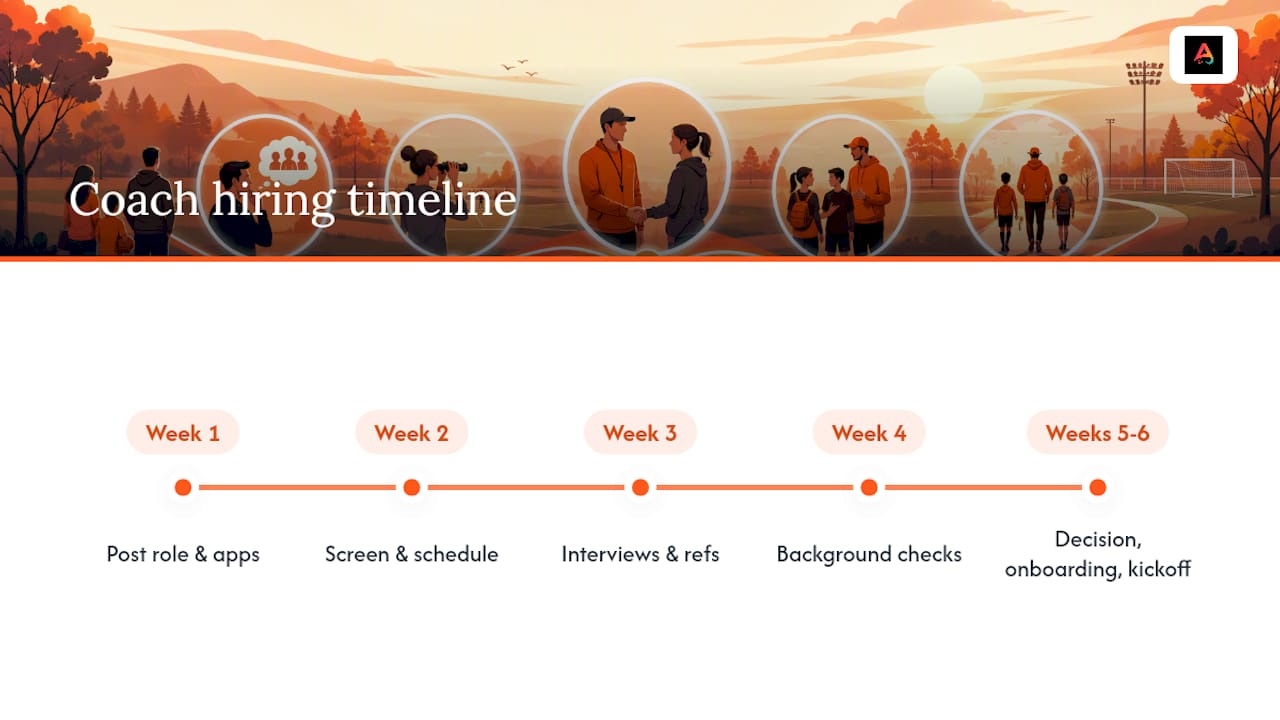
Budget four to six weeks from posting the role to the coach's first practice, if you're doing screening properly. Compress that timeline and something gets skipped, usually the background check renewal or a real reference call.
Here's a realistic breakdown: week one is posting the role and collecting applications. Week two is initial screening, resume review, and scheduling interviews. Week three is interviews and reference checks, which take longer than people expect because references don't call back immediately. Week four is background check processing, which can take anywhere from a few days to two weeks depending on the screening vendor and how many jurisdictions get searched. Weeks five and six cover final decision, onboarding paperwork, and the parent kickoff meeting before the first practice.
Rushing this process is the single most common reason leagues end up with a coach who wasn't properly vetted. A late-season injury or a parent complaint that reveals a skipped background check costs far more time than the extra week you saved by rushing hiring in July. If you're running a tournament or event alongside a coaching search, a tournament director's playbook covers scheduling logistics that overlap with coach onboarding timing.
How Much Does It Cost to Hire a Youth Coach?
Total cost breaks into three buckets: pay, training, and equipment. Skipping any one of them to save money usually costs more later in turnover or liability.
Pay varies enormously by setting. Recreational league coaches often work as unpaid volunteers or for a small stipend. Travel and club coaches, and private coaches hired for one-on-one or small-group sessions, charge by the hour or session, with rates varying widely depending on region, sport, and the coach's credentials. Rather than guess at a national figure, check rates from coaches actively listed in your sport and area, since local competition drives price more than any national average.
Training costs are smaller but real: SafeSport certification is typically free or low-cost, CPR and first-aid courses run a modest fee through the Red Cross or similar providers, and sport-specific coaching clinics through your state association add another line item. Budget for renewal every one to two years, not just the initial certification.
Equipment costs depend on the sport and level. Basic gear like cones, pinnies, and a first-aid kit is cheap. Position-specific gear, video analysis tools, or specialized training equipment for older competitive teams adds up fast. Build a simple annual budget line for coach-related costs rather than treating each expense as a surprise.

Athlo's Take: Paperwork Kills More Seasons Than Bad Coaching Does
The checklist above works. The problem is almost never the checklist itself, it's that leagues run it on paper, spreadsheets, and group texts, and something falls through the cracks. Centralizing rosters, medical forms, and payments in one place cuts down on the errors that come from juggling five different systems. A coaching marketplace speeds up discovery, but it should never replace the background check or the reference call. Technology helps you organize due diligence. It doesn't do the due diligence for you.
— Abdulazeez
Find and Book Vetted Coaches Without the Spreadsheet Chaos
Athlo is the practical alternative to running your hiring process across five disconnected tools, a coaching marketplace built into a mobile app instead of a folder of PDFs and a group text chain. Once you've screened a coach using the steps above, Athlo's coaching marketplace lets you book them and handle payment through secure escrow, so no one's chasing a check or a Venmo request mid-season.

Medical forms and waivers live in the app alongside your roster, so a parent isn't hunting through email for a signed consent form on game day. Live scores, event tickets with QR entry, and pickup-game discovery through LinkUp round out the same hub, meaning coaches and organizers aren't managing five separate apps to run one program. If you're already using a hiring checklist that centralizes admin work, pairing it with a single app just removes friction from the parts that used to eat your Sunday nights.
Download Athlo on the App Store or Google Play and check out the Athloapp to see who's already listed near you.
Where to Go for Training and Screening Guidance
Confirm best practices directly at the source: SafeSport's parent guidance, NCYS screening guidelines, NFHS hiring guidance, and the Positive Coaching Alliance for practical coaching tips.
Sources
- U.S. Center for SafeSport — Parents
- NCYS recommended guidelines for screening and selection
- NFHS — steps involved in hiring coaches
- US Youth Soccer coaching manual
FAQ
What Is the 70/30 Rule in Coaching?
It's a rough guideline for avoiding over-coaching, not a rigid formula every program follows the same way.
How Much Do Youth Coaches Get Paid?
Pay ranges widely by sport, region, and whether the role is recreational, travel/club, or private lessons, with volunteer coaches often unpaid or working for a small stipend. Check listings for your specific sport and area rather than relying on a single national figure.
How Much Does It Cost to Hire a Private Coach?
Private coaching rates vary by sport, session length, and the coach's credentials, and pricing is typically set locally rather than nationally. Comparing active listings on a coaching marketplace like Athlo's coaching page gives a realistic sense of current rates in your area.
Is Hiring a Youth Coach Worth It?
For skill development and safety, yes, a properly screened and trained coach reduces injury risk and improves the coaching experience for kids, according to guidance from NFHS and SafeSport. The value comes from doing the screening and interview steps properly, not from simply filling the role fast.